

UNESCO Digital Learning Week 2026 Held in Paris and BNU Professor Huang Ronghuai Invited to Share Insights
From September 8 to 11, UNESCO Digital Learning Week 2026 was held at UNESCO Headquarters in Paris. Professor Huang Ronghuai, Co-Dean of Smart Learning Institute of Beijing Normal University and Chairholder of the UNESCO Chair on Artificial Intelligence in Education, was invited to participate in the event.
With the theme “Education in the Age of AI: Facts, Frictions, Frontiers,” this year’s Digital Learning Week focused on fact identification and evidence-based approaches in the age of synthetic knowledge, the conflicts and tensions arising from the integration of artificial intelligence into education, and emerging frontiers in educational innovation. Participants explored how education can pursue truth, respond to change, and foster innovation in the age of intelligence, while emphasizing the preservation of education’s public mission and human agency.
At the opening ceremony, Khaled El-Enany, Director-General of UNESCO, and Amandeep Singh Gill, United Nations Under-Secretary-General and Envoy for Technology, delivered remarks. Chen Qun, UNESCO Assistant Director-General for Education, chaired the opening ceremony, while Doreen Bogdan-Martin, Secretary-General of the International Telecommunication Union (ITU), delivered a video address. The event brought together more than 1,500 participants from countries and regions around the world, including more than 20 education ministers and special representatives, as well as representatives of international organizations, experts and scholars, education practitioners, students, and business representatives.
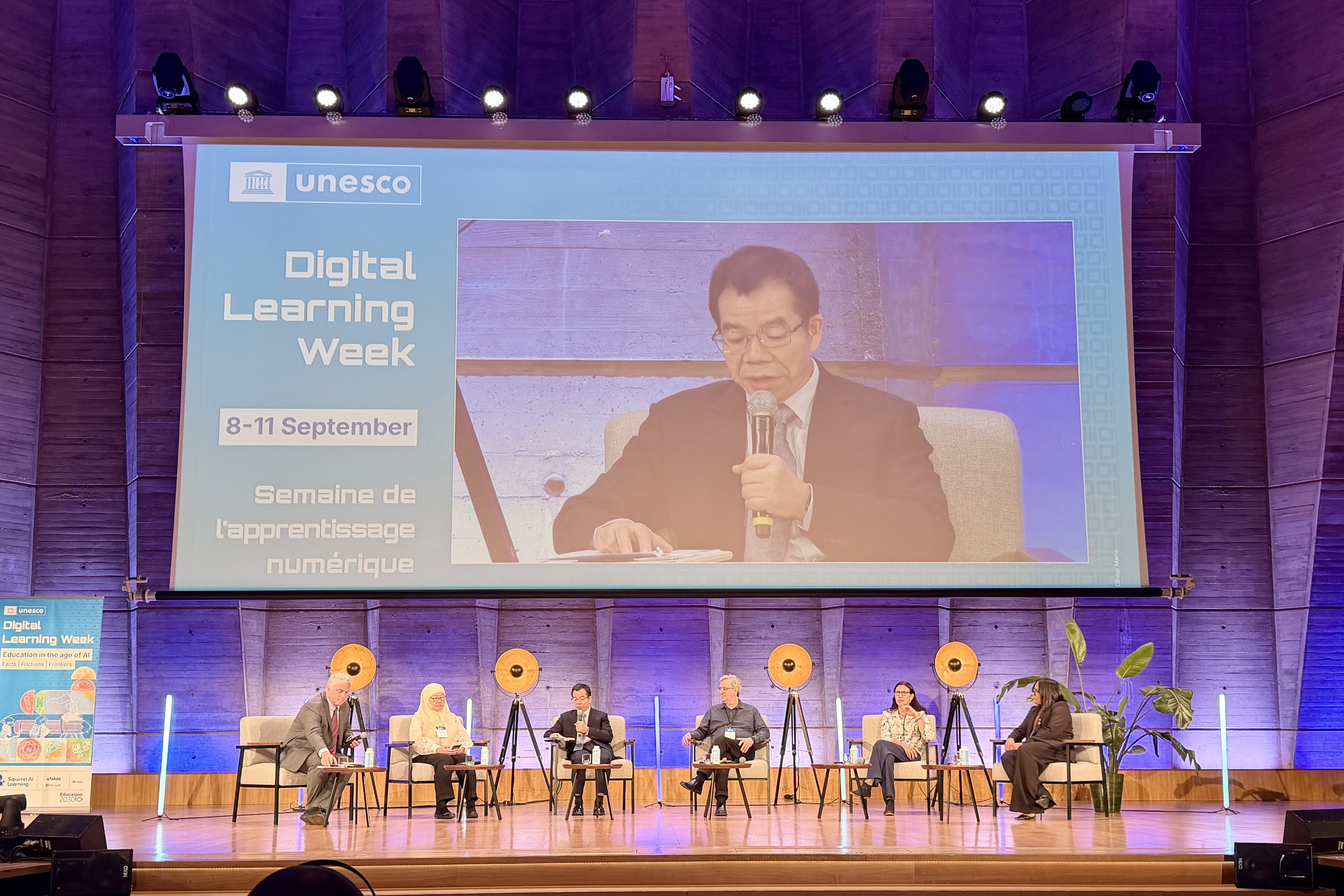
Professor Huang Ronghuai Shares Insights at the Plenary Session of UNESCO Digital Learning Week
Professor Huang Ronghuai was invited to participate in a plenary session and shared his insights at the roundtable discussion on “Higher Education: AI, Talent Ecosystems and Research.”
Drawing on his team’s research into AI innovation practices at 100 universities across 30 countries, Professor Huang summarized several emerging trends in talent development in higher education. First, greater emphasis is being placed on cultivating AI literacy.
Through general education courses and university-wide training, more students are being equipped with the ability to apply artificial intelligence. Second, greater attention is being given to interdisciplinary learning and practice-based education. Through university-industry collaboration, internships, practical training, and other approaches, institutions are promoting the integration of disciplinary learning with AI applications. Third, lifelong learning is receiving increased attention. Micro-credentials, flexible training, professional certification, and other pathways are being developed to support graduates in continuously updating their knowledge and enhancing their skills.
Professor Huang noted that, in response to new developments and emerging needs, universities should reconsider their talent development goals and place greater emphasis on students’ lifelong capacity for independent learning, their ability to relearn and adapt in an AI-enabled environment, their capacity to adapt to multiple forms of flexible employment, their ability to navigate uncertainty, and their ability to thrive in intelligent environments.
He recommended that governments strengthen overall coordination, incorporate AI literacy development into higher education priorities, increase investment in teacher training and shared educational resources, and provide targeted support to universities with relatively limited resources. Universities should deepen reforms in curriculum design, teaching, and assessment by integrating AI literacy into disciplinary education, thereby cultivating students’ independent thinking and autonomous judgment and laying a foundation for employment and lifelong learning. Research funding and academic evaluation mechanisms should also be adjusted accordingly. At the same time, however, human agency must remain central. Institutions should guard against excessive “cognitive outsourcing,” uphold academic standards, and ensure accountability for both research processes and conclusions.
Professor Huang also introduced the Smart Education Social Experiment, initiated under the leadership of the UNESCO Chair on Artificial Intelligence and Education. Based on real-world educational and teaching contexts, the initiative uses large-scale, long-term observation and interdisciplinary research to explore the patterns and mechanisms through which emerging technologies influence educational transformation. It aims to provide empirical support for the responsible use of AI in education, contribute to the achievement of the Sustainable Development Goals in education, and inform the post-2030 education development agenda.
During the conference, Professor Huang also participated in the parallel session on “AI across Disciplines in Higher Education” and other related activities.
About UNESCO Digital Learning Week
UNESCO Digital Learning Week is UNESCO’s annual flagship event promoting digital learning and educational transformation. Since its launch in 2023, the event has brought together representatives from government agencies, international organizations, academic institutions, and the technology sector. Through policy dialogue, research exchange, and the sharing of practical experiences, it seeks to deepen international cooperation and advance a human-centered digital transformation of education.
This year’s Digital Learning Week released a number of outcome documents. Emphasizing the public nature of education, the event proposed eight priority actions, including strengthening a public-interest orientation, safeguarding teachers’ agency, cultivating students’ critical thinking, and promoting equity and inclusion, with the aim of advancing the responsible use of artificial intelligence in education.
UNESCO also released the latest findings from its annual survey on AI in higher education and launched a global consultation on the working paper Safeguarding Education as a Common Good in the Age of Artificial Intelligence: The Need for Consultative Governance, together with six background papers. The consultation focuses on issues including AI safety, age-appropriate use, and digital sovereignty, providing research-based support and policy reference for countries seeking to improve AI governance in education.