

Professor Pan Fenghua's Team from the Faculty of Geographical Science Published an article in Economic Geography
Recently, the research team led by Professor Pan Fenghua from the Faculty of Geographical Science at Beijing Normal University (BNU) published a new paper titled "Upgrading from Contract Manufacturers to Global Lead Firms: The Roles of Regional Institutions, Domestic Consumer Markets, and Global Capital Markets" in Economic Geography. This research uses the sports footwear and apparel industry in Quanzhou, China, as a case study. It explores how local contract manufacturers in developing countries successfully upgrade their brands. Furthermore, the study decodes the underlying mechanisms that allow these businesses to evolve from simple manufacturers within the Global Production Network (GPN) into emerging global industry leaders.
The abstract of this paper is as follows:
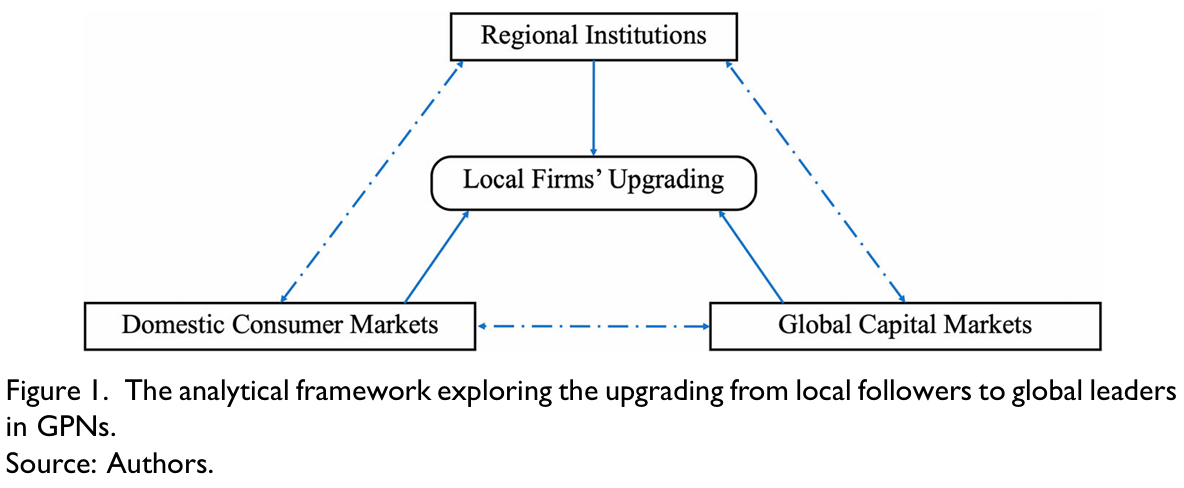
Existing global production network (GPN) literature debates primarily focus on how local contract manufacturers and regions achieve development goals by establishing strategic coupling relationships with global lead firms. Limited attention has been given to whether and how these local firms can establish their own brands and subsequently become global lead firms, let alone identifying the key factors driving this transformation process. By developing an analytical framework comprising regional institutions, domestic consumer markets, and global capital markets, this article unpacks how sportswear firms in Quanzhou, China, have successfully transformed from contract manufacturers to emerging global lead firms with their own brands in GPNs. Through extensive interviews in 2020–24 with Quanzhou-based sportswear firms, local government officials, and industry associations, this article explores how the interplay of the three dynamics has coshaped the brand-centered strategies of local firms in coupling and decoupling from GPNs at different stages. The findings reveal that proactive decoupling from GPNs initiated by contract manufacturers aiming to build their own brands is critical for their further upgrading. Regional institutional support and the rapidly growing domestic market provide confidence and opportunities for local firms to establish independent brands and pursue decoupling strategies. Furthermore, global financing facilitates brand-driven decoupling and further functional upgrading through intensive inputs in research and development and international acquisitions, which enriches our understanding of the significant roles of global financing and its reputational effects in GPN dynamics.