

Professor Huang Ronghuai Led a Delegation to Visit MIT for Exchanges on Open Education and Youth Technological Innovation Education in the Age of AI
On April 17, 2026, Professor Huang Ronghuai, Co-Dean of the Smart Learning Institute at Beijing Normal University (SLIBNU), UNESCO Chair on AI and Education, and Director of the National Engineering Research Center of Cyberlearning and Intelligent Technology, led a delegation to visit the Massachusetts Institute of Technology (MIT) in the United States. The delegation visited both MIT Open Learning and the team of Professor Hal Abelson, Chief Research Scientist at the MIT Computer Science and Artificial Intelligence Laboratory (CSAIL) and a world-renowned computer scientist. The two sides engaged in in-depth exchanges on topics including the development of open educational resources, youth technological creativity education, and AI-enabled lifelong learning. Focusing on two representative MIT teams in the fields of open education and digital innovation education, the visit further strengthened ties between Beijing Normal University and leading international institutions for educational innovation.
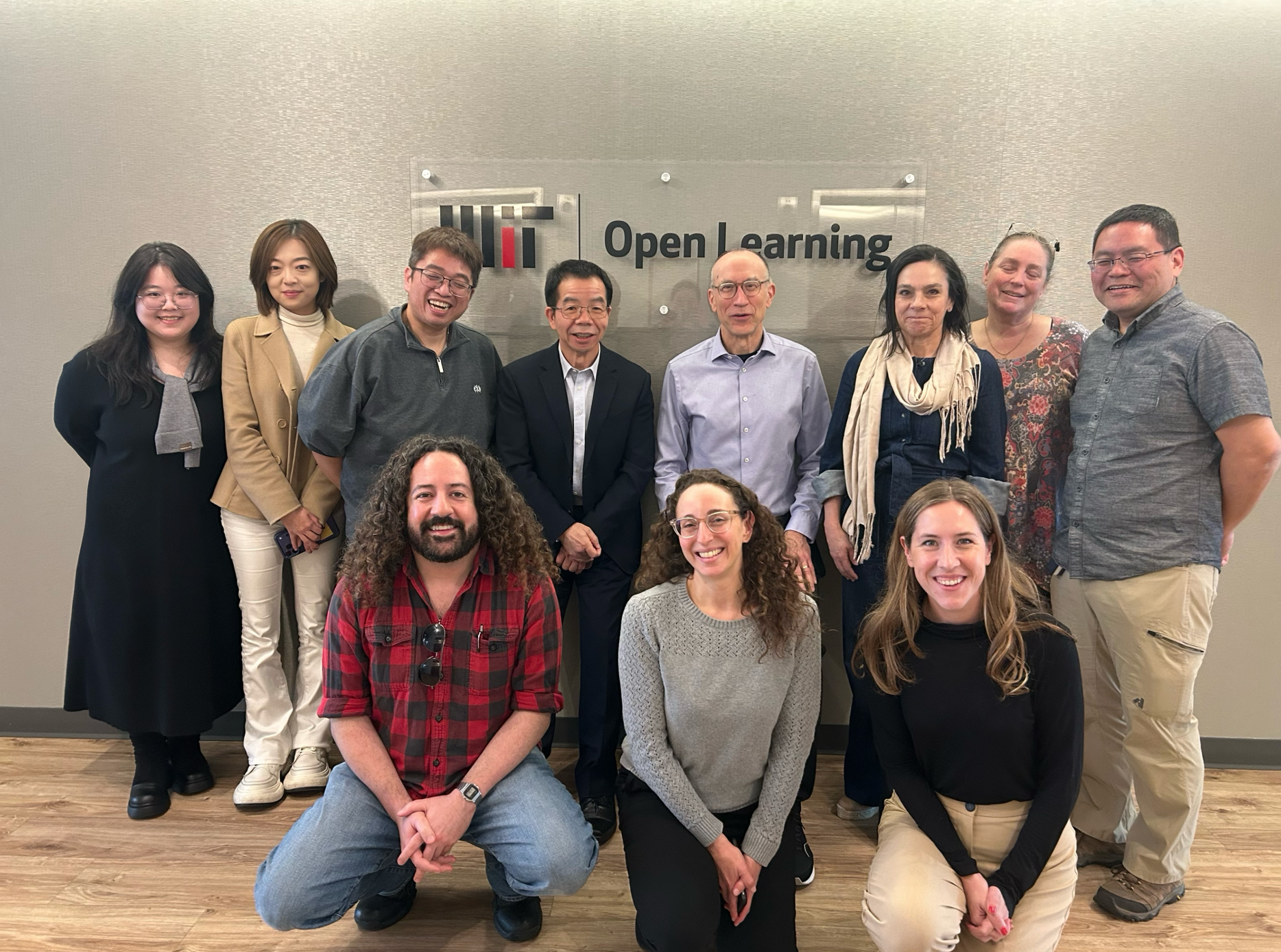
Professor Huang Ronghuai Leads Delegation to Visit MIT Open Learning
On the afternoon of April 17, the SLIBNU team visited MIT Open Learning and held discussions with the MIT OpenCourseWare (MIT OCW) team and related colleagues. As one of the major pioneers of the international open educational resources movement, MIT OCW was officially launched in 2001, stemming from MIT’s forward-looking reflection on the mission of higher education in the internet era. From the outset, it emphasized the open sharing of knowledge rather than the commercialization of online education. Over the past 25 years, the initiative has gradually evolved from an open course materials platform into an important component of MIT’s broader open learning ecosystem, continuously advancing the global dissemination and practice of open education. From its early stage of simply placing course materials online, to developing into an open resource system covering major academic disciplines across the Institute, and then expanding multilingual dissemination, mobile learning support, and lifelong learning services, MIT OCW clearly illustrates the evolution of open education from resource sharing toward learning support.
According to the MIT team, MIT OCW currently offers more than 20,500 course materials from over 2,500 MIT courses to learners worldwide. Over the past 25 years, it has reached more than 500 million users globally, making it one of the most iconic and representative initiatives in the international open educational resources movement. Its influence has long extended beyond the website itself, expanding through search engines, video platforms, podcasts, and open adaptations, and gradually becoming a major public knowledge service for global learners. During the exchange, the MIT Open Learning team also presented its forward-looking innovation agenda. As AI rapidly reshapes education, MIT is advancing open education from mere course openness toward a new stage that places greater emphasis on learning support, ecosystem collaboration, and lifelong learning services. Through initiatives such as MIT Learn, Universal Learning, the Digital Credentials Consortium (DCC), and the PK-12 Initiative, the team highlighted its ongoing efforts in AI-supported learning services, digital credential systems, multilingual resource dissemination, mobile learning support, and innovation in primary and secondary education, demonstrating MIT’s systematic efforts to build a future-oriented learning ecosystem.
On the morning of April 18, Professor Huang Ronghuai and his delegation continued their visit with Professor Hal Abelson’s team at MIT and engaged in in-depth discussions on the MIT App Inventor project. Professor Hal Abelson is one of the leading figures in computer science and digital innovation education at MIT, and his team has long championed the educational philosophy that “Anyone can make an app.”The project originated as an experimental initiative at Google, was later transferred to MIT, and formally developed into MIT App Inventor in 2010. During the exchange, the team noted that the project initially faced challenges in sustaining its development after moving to MIT. However, with the rise of the mobile internet era and the rapid growth of global demand for digital creativity, the project has continued to expand and has gradually become one of the world’s most influential platforms for youth digital innovation practice. It now has approximately 25 million users, who have collectively created 10 billion apps. The project’s core mission has always been to empower ordinary learners not only to use technology, but also to develop applications and solve real-world problems through digital tools. Through a number of vivid student cases, the team demonstrated the project’s educational orientation—as an important tool for helping young people understand the world, respond to social issues, and enhance their sense of self-efficacy. At the same time, the team also introduced its global competitions, teacher and student training programs, and curriculum development initiatives, reflecting its sustained influence in youth digital innovation, responsible AI education, and global educational collaboration.
During the visit, the team from SLIBNU also introduced the Institute’s work and foundations in smart learning environments, AI applications in education, teacher capacity building, international cooperation platforms, and the promotion of global smart education practices. Professor Huang Ronghuai noted that both the open educational resources movement represented by MIT OCW and the youth-oriented technological innovation education advocated by MIT App Inventor offer important points of reference for educational innovation in the age of AI. The former reflects the responsibility of first-class universities in knowledge openness, lifelong learning support, and educational public service; the latter demonstrates how technology education can move beyond learning to use tools toward empowering creativity, enabling learners to develop competence, confidence, and agency through solving real-world problems. These explorations provide important inspiration for rethinking educational transformation, teacher support, and learner development in the age of AI. The visit not only further deepened mutual understanding between the SLIBNU and relevant MIT teams, but also created favorable conditions for sustained interaction and future cooperation in areas such as open education, intelligent technology-supported learning, youth innovation activities, and international academic exchange.