

Complex Social Systems Research Team at the School of Systems Science Published a Paper in Science Advances
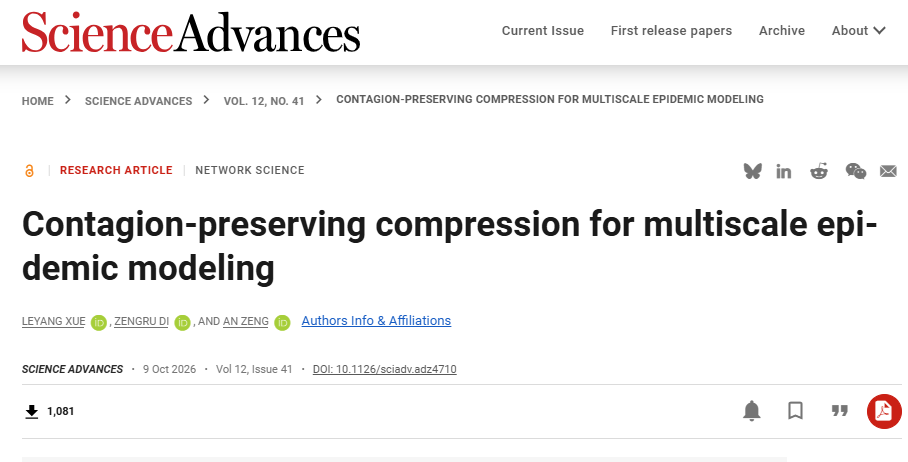
On October 9, the Complex Social Systems Research Team at the School of Systems Science at Beijing Normal University (BNU) published a research paper titled “Contagion-preserving compression for multiscale epidemic modeling” in Science Advances. The study proposes an iterative structural coarse-graining (ISCG) framework that compresses large-scale networks while preserving contagion dynamics, providing a new tool for multiscale epidemic modeling. Xue Leyang, who received his PhD from the School of Systems Science at BNU, is the first author of the paper, and Professor Zeng An is the last and corresponding author. Professor Di Zengru also contributed to the research.
Abstract:
Understanding how contagion unfolds on large, heterogeneous networks is essential for predicting and controlling spreading processes, yet structural complexity often obscures the mechanisms governing transmission across scales. Here, we show that contagion is naturally organized around dense local structures that become dynamical spreading units once infection saturates within them. Building on this principle, we introduce iterative structural coarse-graining (ISCG), a framework that compresses large networks into interpretable multiscale representations while retaining the contagion dynamics of the original system. In this saturation regime, these representations reproduce macroscopic outbreak sizes, node-level infection risks, and spatiotemporal infection trajectories across scales. Beyond this regime, ISCG enables controlled trade-offs between dynamical fidelity and structural compression. The resulting multiscale representations support mechanism-driven intervention strategies, including influence maximization, immunization, and surveillance, that consistently outperform adaptive centrality–based methods. These results establish a general multiscale framework for representing, understanding, and controlling contagion in networked systems.
Reference: https://www.science.org/doi/10.1126/sciadv.adz4710