

Chinese Child Brain Development Cohort Study Reveals ADHD "Brainality Landscape"
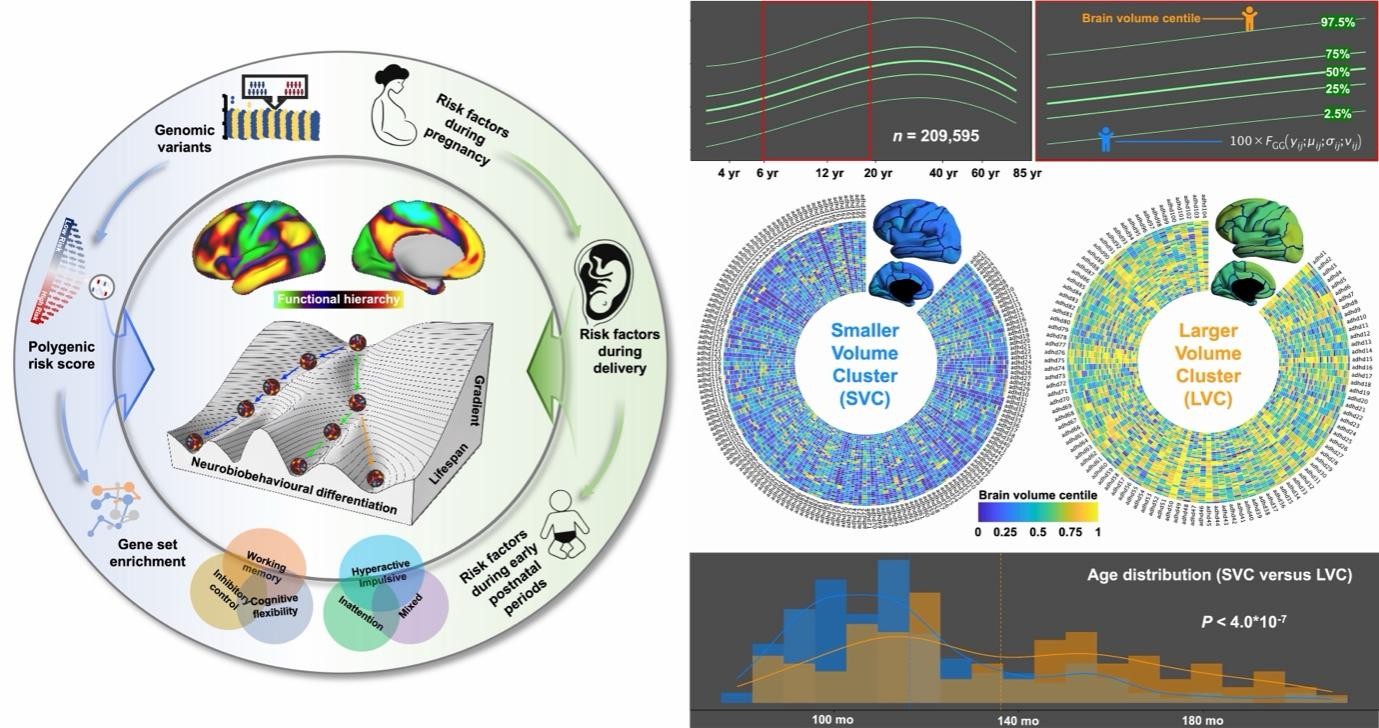
Recently, the Chinese Child Brain Development (CCBD) Consortium, together with the Chinese Human Brain Health Imaging Consortium (CHART), the Chinese Color Nest Consortium (CCNC), and the International Lifespan Brain Chart Consortium (LBCC), in collaboration with the team at Peking University Sixth Hospital, published a research paper titled "Landscaping neurodevelopment of attention-deficit hyperactivity disorder" in Science Bulletin. The study proposed a "Brainality Landscape" research paradigm for developmental population neuroscience, mapped global large-scale human lifespan brain charts (over 200,000 person-times), and on this basis revealed two neurobiological categories of attention-deficit hyperactivity disorder (ADHD) and their distinct developmental landscapes (Figure 1), opening a new path in the science of brain and cognitive development for individualized precision intervention for ADHD.
Abstract:
We aim to decipher the neurodevelopmental diversity of attention-deficit hyperactivity disorder (ADHD) using lifespan brain charts within a brainality landscape framework. It first generated age- and sex-referenced centile scores of brain morphology for 270 children with ADHD by revising the worldwide lifespan brain chart (n = 177,701) for 31,894 healthy Chinese samples, including 25,768 scans from the Chinese Brain Health Imaging Consortium (CHART) and 6126 scans from the Chinese Child Brain Development (CCBD) study. Children with ADHD were then classified using partitioning around medoids based on their centile scores as deviations from a developing control reference to identify trait constellations underlying ADHD’s landscape heterogeneity. The brainality landscape identified two neurotypes: children with smaller volume (SVC-ADHD) and children with larger volume (LVC-ADHD), who are not different between sex, imaging site, gestational and maternal age as well as clinical symptom composition. SVC-ADHD children are younger and have lower mean birth weight, and showed neurocognitive impairments and poorer hemispheric differentiation within the default network as well as more gene expressions related to organism developmental processes, and more prenatal risk factors such as maternal passive smoking. In contrast, LVC-ADHD children are older and demonstrated more pronounced behavior and emotional impairments, while their language, somatomotor, and cognitive control networks exhibited poorer hemispheric specialization. Genetic findings were less pronounced in LVC-ADHD and remained exploratory and mainly linked to neurogenesis. Our work charted the brainality of ADHD to reflect distinct developmental profiles with combinations of genetic, prenatal, and later-life influences, implying clinical potential of future precision translation.
Reference: https://doi.org/10.1016/j.scib.2026.09.001