

Professor Zheng Yonghe's Team from the Research Institute of Science Education at Beijing Normal University Published a Comment Article in Nature
The key to global competition in science and technology lies in talent, and its foundation is education. High-quality science education serves as the foundational project for the integrated development of education, science and technology, and human resources.
Recently, a team led by Professor Zheng Yonghe from the Research Institute of Science Education at Beijing Normal University published a comment article titled "Innovation starts in schools: lessons from China" in Nature. The article was prominently recommended on the cover of the current issue. Focusing on the significant progress and typical experiences of China's science education policies and practices, the piece shares the Chinese story of innovative development in science education.

Tao Dan, an associate research fellow at the Research Institute of Science Education, is the first author. Professor Wei Rui from the College of Chemistry and Professor Zheng Yonghe, Dean of the Research Institute of Science Education, serve as the co-corresponding authors. Based on the localization path of cultivating scientific and technological innovation talents in China, this article systematically expounds the foundational role of science education in the basic education stage. Combining the promotion of science education policies and practical achievements in China in recent years, it condenses the policy implications of science education supporting the innovation-driven development strategy.
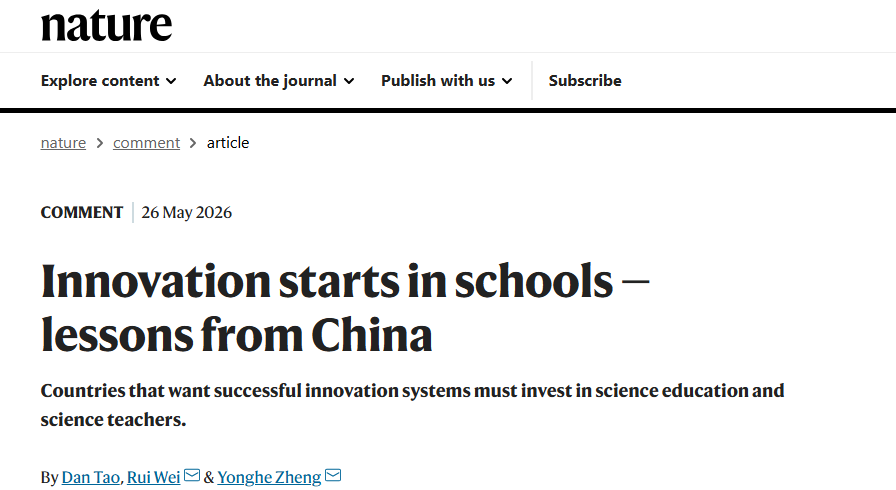
The full text of the article is as follows:
In early 2025, the Chinese artificial-intelligence company DeepSeek, based in Hangzhou, unveiled DeepSeek-R1, a high-performance large language model developed at a fraction of the cost of its Western counterparts. Silicon Valley investor Marc Andreessen called it “AI’s Sputnik moment”. Later that year, Chinese robotics firm Unitree, also based in Hangzhou, released its R1 humanoid robot, which has capabilities approaching those of much more expensive Western systems. Together, these advances have revived a global debate about how nations cultivate and secure technological leadership.
The composition of teams at these firms is revealing. DeepSeek’s research cohort is mostly domestically trained, with many members under 30. Unitree’s engineers are similarly young and trained mainly in China.
Together, these cases suggest that cutting-edge innovation need not depend on researchers learning skills overseas and returning to their home country. A homegrown pipeline for talent is possible — but the model must be sustainable. How can countries build one strong enough to support innovation over time? The answer is to start at the earliest stages of education.
Competition for talent is growing
For decades, China, like many other countries, built its scientific capacity through a narrow pathway: high-stakes exams selected top students, elite universities concentrated resources to train them, overseas positions supplied them with advanced expertise and their return replenished domestic research leadership. That model was effective for catching up with technological developments being pioneered elsewhere. But it rested on global conditions that are becoming less reliable.
As geopolitical tensions disrupt cross-border study, research collaborations and talent flows — and as many countries, including China, continue to face limitations in attracting foreign talent1 innovation systems can no longer rely on a global pool of mobile elite talent alone. But to sustain a domestic model of innovation, the key question is where that domestic talent base comes from — and how it can be built up from scratch.
Innovation policy must move upstream
The answer lies in how scientific talent develops. It does not begin with specialization at university, but evolves in stages: preschool and the early primary or elementary years shape curiosity and hands-on skills; upper elementary and secondary-school education foster critical thinking and conceptual understanding; and higher education refines specialization and career trajectories2. Systems that invest mainly at the final stage are therefore trying to reap innovation from inadequate foundations.
This helps to explain why education reforms announced in China in 2025 are directing more attention upstream. The aim is no longer simply to expand science teaching in the classroom, but to build a broader science-learning ecosystem across all educational levels. Initiatives such as the Fertile Soil Plan (see go.nature.com/4rt8ip; in Chinese) aim to cultivate scientific literacy and strengthen the innovation capabilities of primary- and secondary-school students by replacing rote coverage with interdisciplinary, hands-on, project-based learning tied to real-world problem solving. The wider ambition is to engage students at earlier educational stages in how science is actually done: posing questions, conducting experiments, testing ideas and working across disciplinary boundaries.
The shift also requires schools to become more open to the wider scientific community. Universities, national laboratories and technology firms can give students access to labs, tools and mentors that schools alone cannot provide. With education researchers as the linchpin, these partnerships drive collaborative efforts to develop rigorous curricula that teachers can actually implement in the classroom. By translating cutting-edge science and fields that are national priorities into learning content, these partnerships enhance the contemporary relevance of primary- and secondary-school science education.
Initiatives such as the Standout Programme move further in this direction by allowing secondary-school students to pursue more individualized pathways, including engagement in authentic research and early exposure to emerging fields — opportunities once reserved mainly for those in higher education.
Teachers are innovation infrastructure
But these reforms will matter only if schools have teachers who can turn ambitious policy goals and external partnerships into sustained classroom experiences. This is where many science-education reforms encounter their hardest constraint.
A 2021 national survey of more than 131,000 primary-school science teachers in China found that more than 70% lacked a background in science, technology, engineering or mathematics (STEM); many taught science only part time; and most had limited access to high-quality professional-development resources3. The bottleneck, in other words, is beyond curriculum design or institutional ambition, extending to the capacity of the teaching workforce.
This is not a uniquely Chinese problem. It is a global bottleneck in innovation systems. Across the United States4, Europe5 and elsewhere6, school systems are struggling to recruit and retain qualified science teachers, and failing to prepare and support them adequately. The challenge cannot be solved just by hiring more science teachers. Stronger systems are needed to assist teachers, from high-quality education during training to sustained professional learning after entering the classroom. That is why teacher education and professional development must be treated not as a peripheral education issue, but as part of innovation infrastructure.
China’s response has been to build a more coherent system of teacher preparation and support. One important adjustment is in pre-service teacher training. For decades, teachers received their foundational training in China’s ‘normal’ universities (which focus on educational research and teacher education); they accessed in-service professional development through a separate institutionalized teaching-research system.
China is now centring its teacher-education system on the normal universities and expanding collaborations with high-level comprehensive universities to create a new landscape of complementary strengths and shared resources.
For instance, since 2023, the National Excellence Program has required leading research universities, including institutions such as Peking University and Tsinghua University, both in Beijing, help to prepare a new generation of STEM teachers. This is not simply about using famous universities to make the programme seem prestigious. It is about preparing future teachers at institutions where science is produced as well as taught. By November 2025, the programme had attracted more than 15,000 applicants across 43 top-tier universities, rapidly injecting elite talent into basic education.
The same logic extends to the existing workforce. China’s national science-literacy-enhancement programme for teachers brings together the research capacity of the Chinese Academy of Sciences and the pedagogical expertise of leading teacher-education institutions to give in-service teachers direct exposure to the frontiers of science and research.
In 2024, a national museum–school collaboration, led by the China Science and Technology Museum in Beijing, organized 24 intensive workshops across China, training 2,587 primary- and secondary-school educators and science coordinators. The programme yielded 426 jointly developed curricula, and overall participant satisfaction reached 96%.
These early results suggest that access to scientific communities and institutions can quickly strengthen teachers’ pedagogical capabilities, knowledge of cutting-edge research and understanding of the ways that science is done.
These efforts also point to a harder political reality: building innovation capacity through schools demands patience. Critics might argue that investment in school science and teacher development takes too long to pay off, especially when governments face immediate pressure to fund advanced labs, industrial subsidies and strategic technologies. But this objection mistakes speed for resilience.
Education is a long game
The fragility now visible in many countries’ innovation systems is itself the product of years of underinvestment in the earlier stages of talent development. Zhejiang province, the birthplace of both DeepSeek and Unitree, offers a useful demonstration.
Long before DeepSeek and Unitree drew global attention, Zhejiang had spent decades strengthening integrated science curricula, expanding elective science learning and investing in science-teacher development7. Crucially, since 2016, the province has integrated both general technology and information technology as elective options in its high-stakes university-entrance examination. Indeed, a 2023 survey of more than 23,000 secondary-school graduates in the province revealed that core competencies in engineering thinking and technological design have flourished because nearly every student had gained practical experience in design and manufacturing, bolstering their aspirations in these fields. This does not prove a simple causal chain from school reform to technological success. But it does show what long-term investment can make possible: a deeper pool of scientific talent, from which future innovators can emerge.
The lesson extends beyond China. Open science, international collaboration and corporate research and development remain essential. But they cannot compensate for a weak domestic base of scientific talent, nor can they substitute for the teachers who build the talent in that pipeline over time.
Leaders should act now
Countries that want durable innovation systems must therefore widen their definition of innovation policy. It does not begin only in elite labs or high-tech firms — it also begins in school systems that can sustain scientific curiosity, rigorous teaching and meaningful engagement with how science is done.
National science funders should devote part of their innovation budgets to science-education research, long-term school–scientist partnerships and teacher support, rather than reserving strategic funding almost entirely for advanced research and industrial scale-up.
Research universities, national labs and scientific academies should treat partnerships with schools and teachers as part of their public mission, not as peripheral outreach.
Education ministries, local school systems and curriculum and examination authorities should align staffing, professional learning and assessment with the goal of cultivating scientific talent earlier and more broadly.
Industry, too, should contribute by offering real-world problems, mentors and placements that connect school science to emerging fields.
Countries that neglect these investments might still build excellent labs. They will find it much harder to build the talent that those labs need.
Source: Tao, D., Wei, R. & Zheng, Y. (2026). Innovation starts in schools – lessons from China. Nature, 653, 1005-1007.
Reference: https://www.nature.com/articles/d41586-026-01620-7