

Mrs. Lore Harp McGovern and Her Delegation Visited Beijing Normal University
On April 28, Lore Harp McGovern and Xiong Xiaoge, Chairman of IDG Capital, along with their delegation, visited Beijing Normal University (BNU). Yu Jihong, President of BNU, and Wang Ming, Vice President of BNU, met with the guests. Dong Qi, former President of Beijing Normal University and Professor at the Faculty of Psychology, Luo Liang, Dean of the Faculty of Psychology, and Wang Xiaoqun, Director of the IDG/McGovern Institute for Brain Research at BNU also attended the meeting.
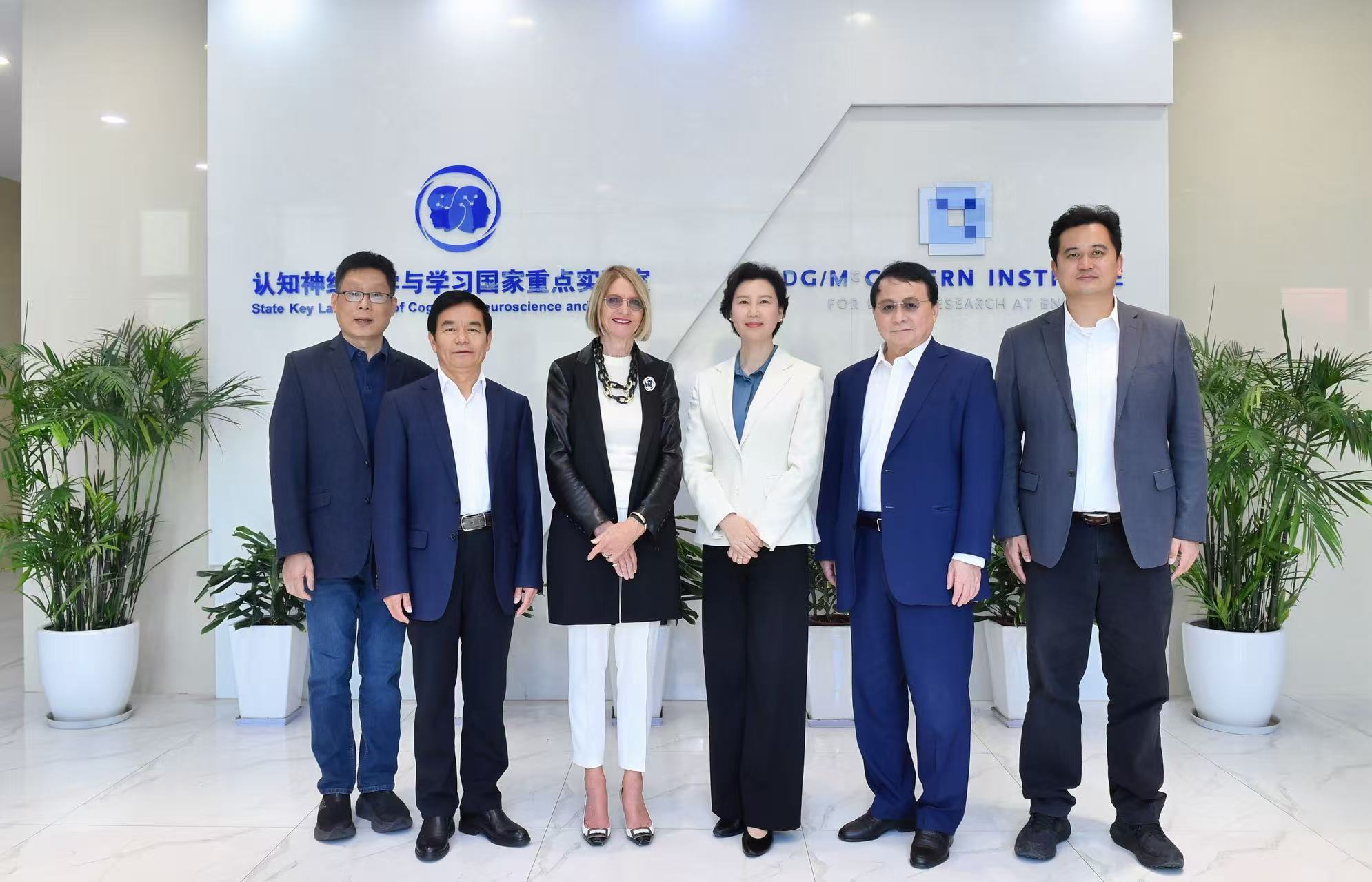
Yu Jihong and the guests laid flowers at the monument of Mr. Patrick J. McGovern, and presented BNU commemorative gifts to Lore Harp McGovern and Hugo Shong, expressing gratitude for their long-term support to the construction and development of the IDG/McGovern Institute for Brain Research at BNU.
At the symposium, Wang Ming stated that after fifteen years of relentless effort, the institute has achieved gratifying results. Grounded in the core research direction of "learning and brain plasticity," it has brought together multidisciplinary strengths from psychology, education, cognitive neuroscience, neuroimaging, computational neuroscience, and other fields. The institute has produced a series of original research outcomes in many areas. It has gradually become a globally renowned hub for brain research in children and adolescents. He expressed the hope that the institute would carry forward the scientific vision and philanthropic spirit of Mr. McGovern and IDG Capital to further advance brain science and make even greater contributions to basic childhood education and the healthy development of children and adolescents.
Wang Xiaoqun reviewed and presented the development of the IDG/McGovern Institute for Brain Research at BNU over the fifteen-year period from 2011 to 2026. Lore Harp McGovern and Hugo Shong highly commended the institute's progress and achievements. The two sides exchanged views on topics such as brain science research projects and grassroots talent cultivation, reaching broad consensus.
In the future, the institute will adhere to a dual-driver model of basic research and social service, continue to recruit young talents, focus on research concerning children and adolescents aged 0–18, aim to become a global core hub for child brain development research, promote cross-disciplinary innovation at the intersection of education and neuroscience, and support the healthy growth of children through high-level research.