

"One World, One Love" 2026 International Day of Sign Languages Thematic Event & Seminar on Artificial Intelligence in Special Education Held
On September 23, the International Day of Sign Languages, the 2026 International Day of Sign Languages Thematic Event & Seminar on Artificial Intelligence in Special Education, co-hosted by Beijing Normal University(BNU) and the Arab League Educational, Cultural and Scientific Organization (ALECSO), was held in Beijing under the theme "One World, One Love." With "Sign Language, Disability and Digital Technology" as its core topic, the event brought together representatives from China, the Arab region, Southeast Asia, and international organizations, as well as from academia, disability communities, and the technology sector. Through innovative project showcases, the release of a global sign language video, expert reports, and roundtable discussions, participants jointly explored the opportunities and challenges of artificial intelligence and digital technology in sign language communication, inclusive education, digital accessibility, and the protection of the rights of persons with disabilities, with the aim of fostering a more inclusive, accessible, and people-centered new ecosystem for digital education.
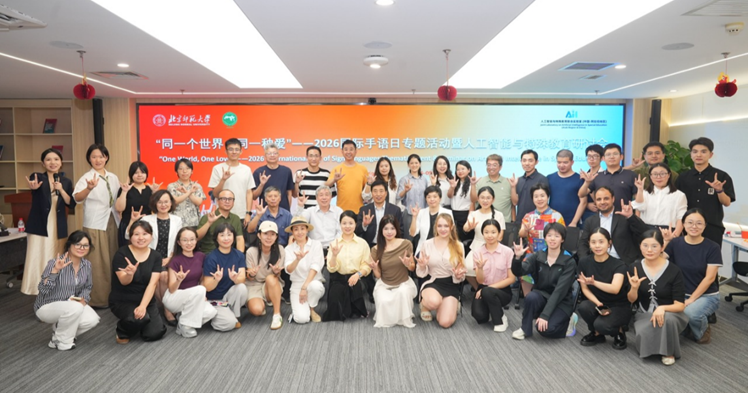
Liu Peijun, Director-General of the Department of Language and Text Information Management of the Ministry of Education of the People's Republic of China, noted in his opening address that the fields of education and language affairs have long been advancing sign language policy development, scientific research, and standard-setting. In the future, modern technologies such as artificial intelligence will be used to promote the professionalization, standardization, digitalization, and internationalization of sign language, and to enhance the capacity of sign language to serve special education and social participation.
Mohamed Ould Amar, Director-General of the Arab League Educational, Cultural and Scientific Organization (ALECSO), stated that digital technology and artificial intelligence can help remove barriers, but only on the premise of adhering to inclusive design and keeping human needs at the center. "Technology is not the end; people themselves are the end." ALECSO is ready to work hand in hand with countries and international partners to promote the building of a more inclusive society, more equitable education, and more human-centered technology.
Shahbaz Khan, Director and Representative of the UNESCO Regional Office for East Asia, stated that artificial intelligence and digital technologies can expand opportunities for persons with disabilities in education, communication, and social participation, but a lack of inclusive design may also create new barriers. Digital transformation should adhere to a people-centered approach and promote the integration of sign language and the deaf and hard-of-hearing community into the digital future. Artificial intelligence should uphold the principles of inclusiveness, ethics, and accessibility, and persons with disabilities should actively participate in its development and governance.
Cui Ruifang, Deputy Director of the Department of Education and Employment of the China Disabled Persons' Federation, stated that the Chinese government attaches great importance to sign language work and has continuously safeguarded the legitimate rights and interests of persons with hearing disabilities by improving laws and policies, advancing research and standard-setting, and strengthening talent cultivation. In the future, efforts will be made to promote the deep integration of artificial intelligence with sign language and special education, advance the informatization of sign language, and strengthen international exchanges and cooperation, so that technology can better serve the learning, life, and development of persons with disabilities.
Zheng Xuan, a professor at the Faculty of Education of Beijing Normal University, pointed out in her address that sign language is the language and cultural carrier of the deaf and hard-of-hearing community, and that digital technologies such as artificial intelligence have become a key bridge for promoting equal participation. She emphasized that the digital transformation of special education is not merely a matter of technological innovation, but more importantly, it should enable every person to be heard, understood, and accepted equally and with dignity, embodying the principle of "Nothing about us without us."
Chen Guangju, Vice Dean of the Smart Learning Institute, attended the event and delivered an address. The event was moderated by Wang Junyi, Senior Program Officer of the Center for International Exchange and Cooperation at the Smart Learning Institute of Beijing Normal University.
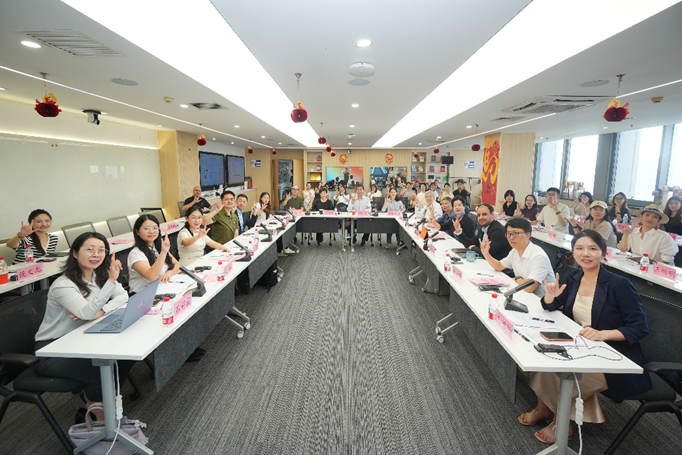
During the event, Assoc. Prof. Ahmed Tlili and postdoctoral researcher Chen Ying from Beijing Normal University introduced the background, development goals, and practical explorations of the Joint Laboratory on Artificial Intelligence and Special Education (China–Arab Region). At the event, the team showcased an AI-assisted gamified intervention platform for children with autism, an AI sign language learning platform, a wearable silent speech interaction system, a multilingual learning resource generation tool, an EEG feedback and attention training system, and a motion-sensing interaction project for children with hearing impairments, covering areas such as sign language learning, language interaction, social-emotional development, and personalized learning. The joint laboratory has also drawn the attention of the United Nations' Global Dialogue on AI Governance.
The Joint Laboratory on Artificial Intelligence and Special Education (China–Arab Region) released the One World, One Love global sign language video. The video solicitation campaign was launched three months ago and received a total of 35 submissions from 12 countries, ultimately bringing together 7 sign languages, including 6 sign languages from the Arab region and Chinese Sign Language, presenting sign language expressions from different countries and regions. The video was released by Mohamed Jemni, Director of the ICT Department at ALECSO. He stated that the global sign language video uses sign language as a bond to connect participants from different countries, cultures, and communities, conveying shared humanistic emotions and the concept of inclusiveness through diverse languages.
Several experts delivered keynote reports, stating that sign language technological innovation and the safety and security of the deaf and hard-of-hearing community are not only a technological proposition but also a rights proposition. In the future, it is necessary to adhere to a people-centered and rights-oriented approach, strengthen human-machine collaboration, expert review, and community participation, and promote technology from "achieving accessibility" to "promoting action," so that every deaf and hard-of-hearing person can be understood and protected at critical moments and share in the safety and dignity of the digital age.
In the AI-Empowered Special Education Achievements Exhibition and Experience session, six achievements were showcased: a motion-sensing interaction system for children with hearing impairments, brain-computer interface technology, a wearable vibration-based speech acquisition system, a game system for children with autism, a Braille translation platform, and "Sign Language Universe"(a sign language learning platform). The projects cover groups including those with hearing impairments, autism, and visual impairments, and span scenarios such as motion-sensing interaction, neurotechnology, speech acquisition, game-based intervention, Braille translation, and sign language learning, vividly presenting the innovative practices and application prospects of artificial intelligence empowering special education.
With International Day of Sign Languages as a bond and artificial intelligence and digital technology as its entry point, the event built a cross-regional and cross-sector platform for exchange and cooperation. Participating parties consolidated a consensus on inclusiveness, promoted diverse dialogue, jointly explored practical pathways for accessible and inclusive digital design, and advanced collaborative innovation among disability communities, academia, and the technology industry. Looking to the future, Beijing Normal University will continue to leverage its disciplinary and technological strengths, supporting policy through scholarship and conveying warmth through technology, to help build a high-quality, inclusive, and universally beneficial development framework for special education.
The event was jointly organized by the UNESCO Chair on Artificial Intelligence and Education (AIED) at Beijing Normal University, the School of Special Education of the Faculty of Education at Beijing Normal University, and the Joint Laboratory on Artificial Intelligence and Special Education (China–Arab Region), with support from the UNESCO Regional Office for East Asia, the SEAMEO Regional Centre for Special Educational Needs (SEAMEO SEN), and the National Research Center for Sign Language and Braille.