

Global Smart Education Conference 2026 Opens in Beijing
On August 18, the Global Smart Education Conference 2026 (GSE 2026), co-hosted by Beijing Normal University (BNU) and the UNESCO Institute for Information Technologies in Education (UNESCO IITE), opened in Beijing. Under the theme “AI and Education for Sustainable Development”, the conference gathered experts, scholars and front-line educators across global education, technology and industry sectors. Centering on sustainable-development pathways for the in-depth integration of artificial intelligence and education, participants shared new theories, technologies and practices of smart education. They jointly explored a new model for equitable, inclusive, high-quality and universally-accessible global education in the intelligent era, and helped deliver tangible progress towards United Nations Sustainable Development Goal 4 (SDG4).
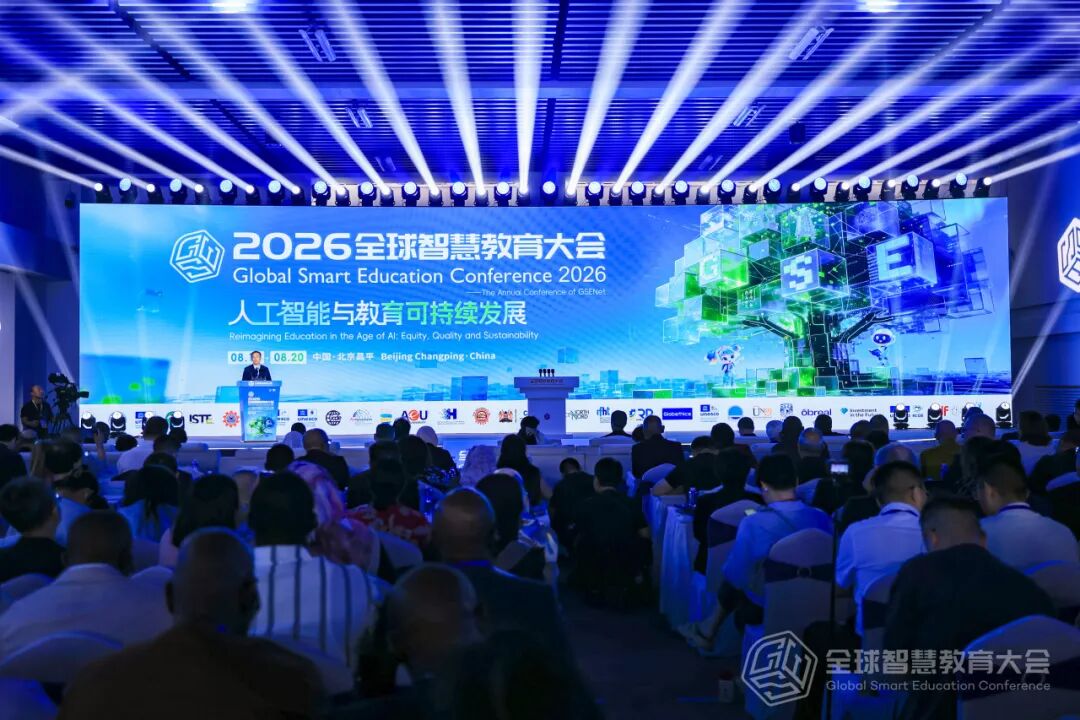
Upholding the Founding Mission of Nurturing People to Guide Sustainable Development of Education
Sustainable development of education stands as a core target of the United Nations 2030 Agenda, as well as the value benchmark for educational transformation in the intelligent era. At present, artificial intelligence, as a leading, strategic and disruptive force, is profoundly reshaping the global economic and social landscape and imposing unprecedented demands for transformation upon education. How to advance the in-depth integration of artificial intelligence and education so that technology truly serves holistic human development, educational equity and quality improvement has become a shared question of our times across the globe.
Ren Youqun, Vice Minister of Education of the People’s Republic of China and Chairperson of the Chinese National Commission for UNESCO; Yu Jihong, President of Beijing Normal University; and Tang Qian, Co-Chair of the Conference and Former Assistant Director-General for Education of UNESCO, attended and delivered opening remarks at the Opening Ceremony.
Speeches delivered by diverse guests reached a broad consensus: no matter how technology evolves iteratively, the fundamental stance of nurturing people must remain unshaken. Only by firmly anchoring the core of holistic human development, balancing innovative development with ethical constraints, and strengthening transnational communication and collaboration can we translate the transformative power of artificial intelligence into tangible driving forces for educational progress.
Embracing Inclusive and Equitable Development to Build a Global Smart‑Education Community
UNESCO has consistently regarded inclusion and equity as core principles of global educational governance, advocating that no learner should be left behind. Faced with the widening digital divide and AI-application divide amid global digitalization, it is imperative to leverage technology to narrow development gaps, uphold the public nature of education, and jointly build an open and inclusive global smart-education community.
Rabab Fatima, Under Secretary-General and High Representative for the Least Developed Countries, Landlocked Developing Countries and Small Island Developing States of the United Nations; and Chen Qun, Assistant Director-General for Education of UNESCO, delivered video remarks. They called on all countries to scale up digital education development, deepen trans‑national cooperation, tackle sector-wide challenges including AI-enabled educational deployment and the digital divide, and advance equitable and sustainable development of education.
Multiple education ministers shared governance insights drawing on their national practices, including Hon. Dr. Kaviraj Sukon, Minister of Tertiary Education, Science and Research, Mauritius; Hon. Mr. Bright Msaka, Minister of Education, Science and Technology, Malawi; Hon. Mr. Idrissa Samb, Minister of Employment, Vocational and Technical Training, Senegal; Hon. Dr. Mo'ale 'Otunuku, Minister for Education and Training, Tonga; and Hon. Prof. Stella Christie, Vice Minister of Higher Education, Science, and Technology, Indonesia.
A truly global smart-education community that leaves no learner behind can only be achieved by upholding inclusion and equity and accommodating differentiated development aspirations across nations. As Mr. Lester G Huang, Deputy Chairman of The Hong Kong Jockey Club and Deputy Chairman of The Hong Kong Jockey Club Charities Trust, proposed, global smart-education cooperation should be harnessed to connect educational practices from diverse regions, foster experience‑sharing, joint solution-building and exploration for future schools, and guarantee equitable learning opportunities for all students.
Unveiling Smart-Education Practical Outcomes for Mutual Learning and Global Knowledge-Sharing
Against diverse practical gaps in AI-empowered education, experts, government officials and industry representatives from various countries took advantage of the conference to launch action initiatives, industry standards, authoritative research reports and implement-ready solutions. These outputs cover multiple scenarios including special education, rural education, student development and teacher capacity-building. They consolidate hands-on smart-education experience and help establish a regular global mechanism for mutual learning and knowledge sharing on smart education.
Huang Ronghuai, Co-Dean of the Smart Learning Institute, Beijing Normal University and UNESCO Chair on Artificial Intelligence in Education, together with Shafika Isaacs, Chief of the Section for Technology and AI in Education, UNESCO and Director a.i. of UNESCO IITE, jointly unveiled a landmark deliverable—the Global Smart School Initiative. Launched by the Global Smart Education Network (GSENet), this initiative aims to build an open, inclusive and evidence-informed global cooperation platform. It facilitates practice exchange, professional evaluation, transformation consultation and school certification among schools across countries and regions.
Hu Xiangen, Director of the Educational Research & Technology Center, The Hong Kong Polytechnic University, presented on behalf of his research team the report Pacesetting Global Educational Transformation Report: AI-Driven Innovations from 100 Selected Top Universities. The report systematically sorts out AI implementation practices of 100 top‑tier universities across six continents from 2020 to 2026. It identifies differentiated transformation pathways for various regions and furnishes empirical evidence for higher‑education institutions worldwide to develop compliant, inclusive and sustainable intelligent campus systems.
A suite of landmark research outputs and action deliverables will also be rolled out throughout the conference. These initiatives, reports and solutions strike a balance between macro-level frameworks and on-the-ground implementation. They fully absorb local practical experience from different nations while supplying adaptable toolkits and models. They offer empirical references for smart-education reforms amid diverse national contexts worldwide, and serve as a vital bridge linking theoretical research with real-world practice.
Deepening Industry-Academia-Research Collaborative Innovation to Foster a High-Quality Smart-Education Ecosystem
In‑depth integration of industry, academia and research as well as cross‑sector and transnational collaborative innovation constitute core pathways to accelerate global digital transformation in education. Leveraging platforms including UNESCO, the Global Smart Education Network (GSENet) and the World Digital Education Alliance, academic circles, governments and technology enterprises carry out cross-boundary collaboration. They advance innovation in AI-enabled educational scenarios, build an open-access innovation hub for smart education, and foster a high-quality smart-education ecosystem.
Conference participants delivered a series of keynote speeches covering themes such as Global Vision and Future Education, AI Technology Innovation and Industry-Academia-Research Collaboration, and Building a Smart Education Ecosystem Together. Diverse perspectives from industry, academia and international organizations fully demonstrate that high-quality development of smart education calls for in-depth coordination among all sectors to fully unlock the potential of artificial intelligence.
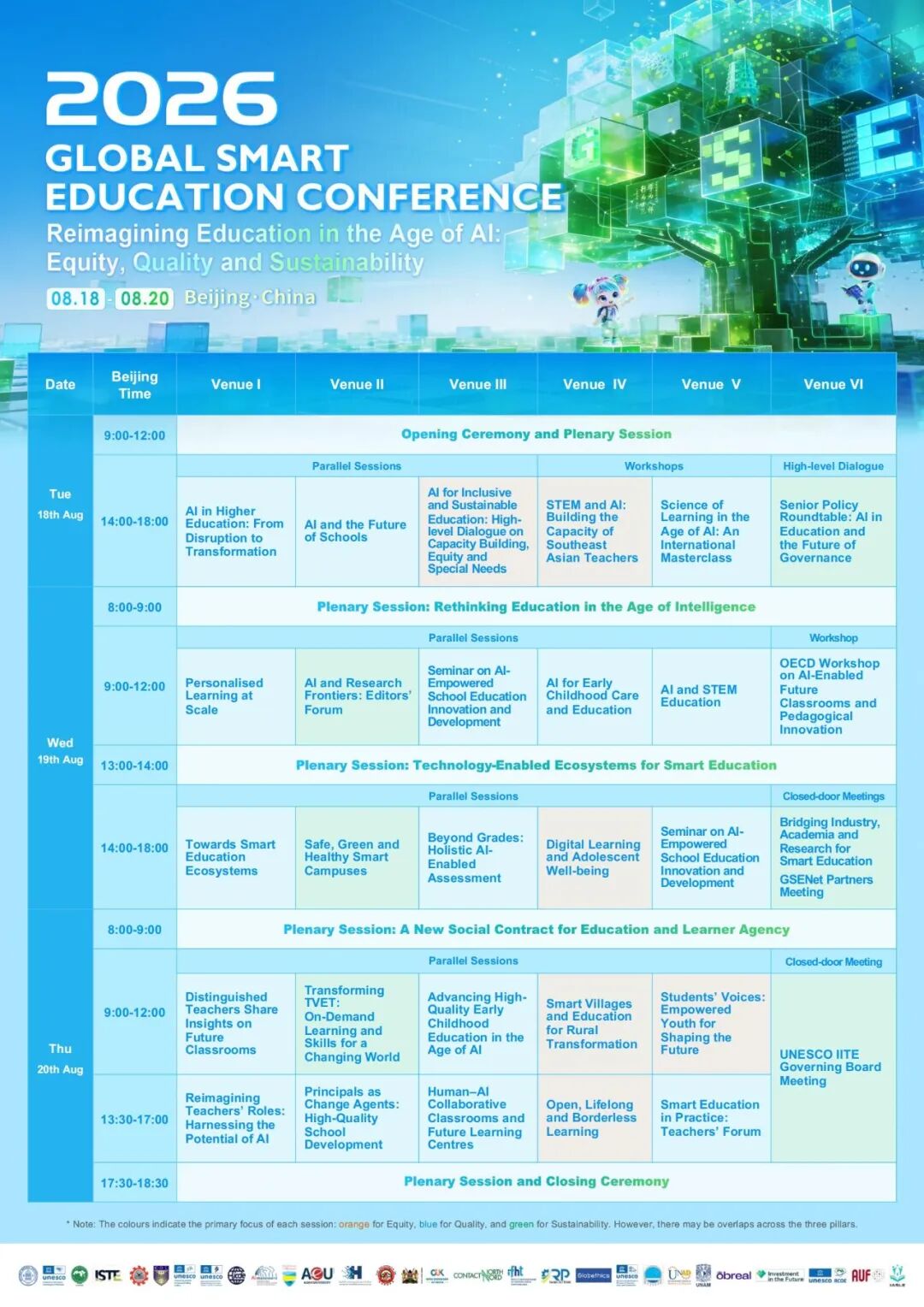
The conference runs from August 18 to 20. It features plenary sessions, parallel sessions and special events covering the full educational continuum including early-childhood education, basic education, higher education, technical and vocational education and lifelong learning. Its agenda addresses topics such as AI-enabled educational governance, personalised student growth and well-being, future teachers, future classrooms, future schools, future-learning centres, integration of science-education and industry-education collaboration. It also focuses on hot-button themes including rural education, special education, learning sciences and intelligent‑society experiments.
Parallel special events held during the conference include the GSENet Partners Meeting, the UNESCO IITE Governing Board Meeting, the Global Finals of the 9th Global Competition on Design for Futures (K-12 Track), Students' Voices: Empowered Youth for Shaping the Future, Bridging Industry, Academia and Research for Smart Education, and the Smart-Education Innovation Achievements Exhibition. These form a multi-level, multi-stakeholder platform for exchange and demonstration.