

The Ornithology Research Team from Beijing Normal University Published an Paper in Nature Communications
A joint research team from Beijing Normal University, the Institute of Zoology of Chinese Academy of Sciences, and University of Bern published a research article in Nature Communications in February 2026. The article is titled "Inbreeding and demography interact to impact the recovery of a bottlenecked crested ibis population."

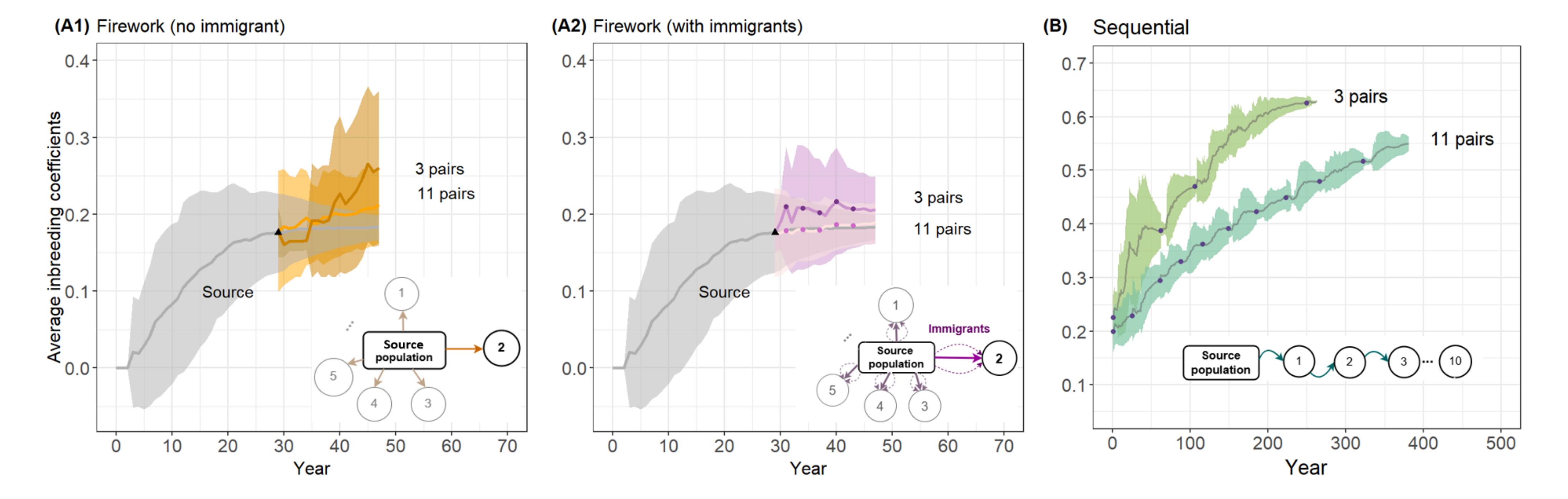
Using advanced theoretical ecology modelling, the study constructed an individual-based model (IBM) based on the breeding life-history parameters of the crested ibis. The model parameters were derived from field data on the breeding ecology of the crested ibis, including clutch size, hatching success, fledging success, nest survival, and stage-specific mortality rates. The model also incorporated aninbreeding-depression equation derived from pedigree data for captive individuals. The researchers used the model to simulate the recovery process of the crested ibis population from an initial bottlenecked population to its current status.
The abstract of this paper is as follows:
Biodiversity loss driven by climate change and human activities poses a critical global challenge. Population restoration and reintroduction programs are essential for mitigating this threat to endangered species, yet their outcomes often remain unpredictable due to poorly understood success factors, such as the inevitable inbreeding during bottleneck events. The conservation programme of the crested ibis (Nipponia nippon) marks a successful example where the population rose from just seven individuals to over 9000 in the past four decades. By developing an individual-based model that simulates the restoration process and incorporates species-specific demography and inbreeding data, we conclude that this successful restoration is largely deterministic, as our results closely mirror empirical recovery time and population-level inbreeding coefficients. To establish general guidelines for reintroduction programs, we compare how inbreeding depression influences the recovery success of two reintroduction strategies involving small founder populations. Our simulations reveal that the ‘firework’ approach (one-source translocations) outperforms the ‘sequential’ (serial translocations) approach in restoration effectiveness. Furthermore, by expanding analyses over a broad demographic space, we demonstrate that the net effect of inbreeding varies with species-specific demography and highlight the importance of considering their interaction when interpreting conservation outcomes and designing future reintroduction programs.
Reference: https://www.nature.com/articles/s41467-026-69278-3