

Professor Chen Ziyue's Team at the Faculty of Geographical Science Published a Paper in Nature Food
Timely and reliable knowledge of crop yield expectations in major grain-producing countries is fundamental to the scientific formulation of agricultural trade policies and the safeguarding of global food security. However, early estimation of crop yields at the global scale has long faced considerable challenges. Recently, a research team led by Professor Chen Ziyue from the Faculty of Geographical Science at Beijing Normal University published a paper titled "An integrative framework for early estimation of global crop yields demonstrated under large-scale disruptions" in Nature Food. The study developed a global early crop-yield estimation framework that integrates national yield statistics, multi-source remote sensing and climate data, global crop calendars, and machine learning, enabling yield estimation for four major crops—wheat, rice, soybean, and maize—across all grain-producing countries worldwide.
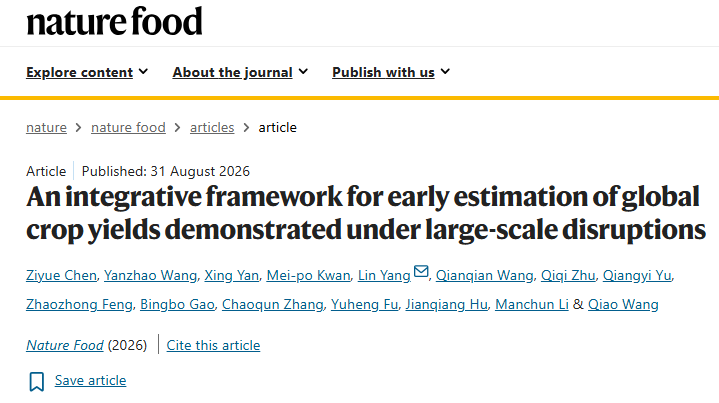
The abstract is as follows:
Expectations of global crop yields, especially in major production countries, strongly influence crop-export policies and global food security, especially during national and global disruptions. Timely yield estimation remains difficult at the global scale because of large differences in crop phenology, environmental conditions and agricultural practices. Here we propose a framework that integrates yield statistics with multi-source remote-sensing and complementary geospatial data, and employs random forest models to estimate major crop yields in all production countries. We selected three cases, the coronavirus disease 2019 global pandemic, Australian wildfires and the Ukraine war, to verify the model performance under different regional and global disruptions. The framework achieved a satisfactory accuracy globally, especially in major crop-production countries with developed agricultural techniques. When croplands were not severely affected by such events as wars or wildfires, this framework even enabled crop yields estimation months before harvest. This research provides a methodological reference for global yield estimation to support timely crop trade policies and reduce food-security risks.
Reference: https://www.nature.com/articles/s43016-026-01418-w