

Professor Duan Jianping's Team at the Faculty of Geographical Science Published a Paper in Nature Communication
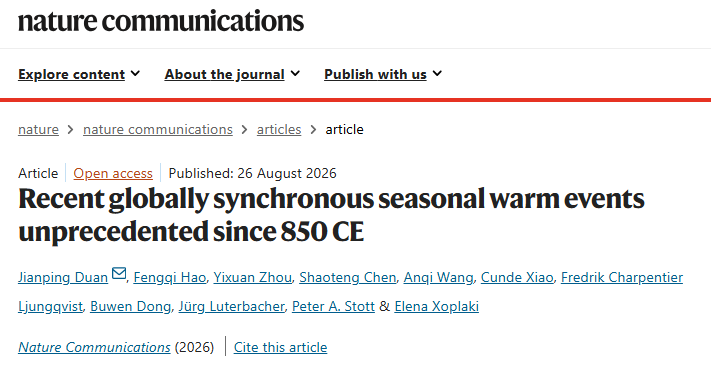
Recently, Professor Duan Jianping's team from the Faculty of Geographical Science at Beijing Normal University published a research paper titled Recent globally synchronous seasonal warm events unprecedented since 850 CE in the journal Nature Communications. The study analyzed the evolution of the extremity of spatially co-occurring seasonal extreme warm events over global land areas during the past millennium, revealing that since the 1970s, the extremity of seasonal extreme warm events has been continuously intensifying, has clearly exceeded the range of natural variability, and has reached an intensity unprecedented over the past millennium. This change is primarily driven by anthropogenic greenhouse gas emissions.
The full abstract is as follows:
Spatially synchronous extreme warm events can amplify environmental and societal impacts by affecting multiple regions simultaneously. However, previous studies have largely focused on June–August (JJA) events during the instrumental period, limiting understanding of their seasonal prevalence and long-term evolution. Here, we examine globally synchronous seasonal warm events (GSSWEs) using seasonal mean near-surface air temperature (SAT) and introduce an Extremity Index (EI) that combines normalized local land SAT anomaly intensity with the spatial extent of land areas exceeding a specified SAT threshold. Using instrumental observations, paleo-reanalysis products and climate model simulations, we assess changes in global-land GSSWE extremity since 850 Common Era (CE). We find that GSSWEs have intensified sharply since the 1970s across all four seasons, reaching levels not found earlier in the multi-dataset records. Detection and attribution analyses indicate that anthropogenic forcing, dominated by greenhouse-gas forcing, is the main contributor to this recent intensification. Spatially, the tropics contribute greatly to the recent extremity of GSSWEs due to their lower intrinsic variability. These findings highlight that climate-risk assessment and adaptation planning need to consider the growing spatial coherence and intensity of seasonal warm extremes.
Reference: https://doi.org/10.1038/s41467-026-76985-4