

GSENet Hosts Fireside Chat on Educational Leadership in the Intelligent Era at ICDE World Conference 2025 in Wellington
From November 10 to 13, the 30th World Conference of the International Council for Open and Distance Education (ICDE) convened in Wellington, bringing together nearly 500 experts and scholars from around the world. Participants exchanged insights on promoting mutual enrichment in teaching and learning, enhancing inclusiveness, scalability, and sustainability in education, and accelerating progress toward the Sustainable Development Goals.
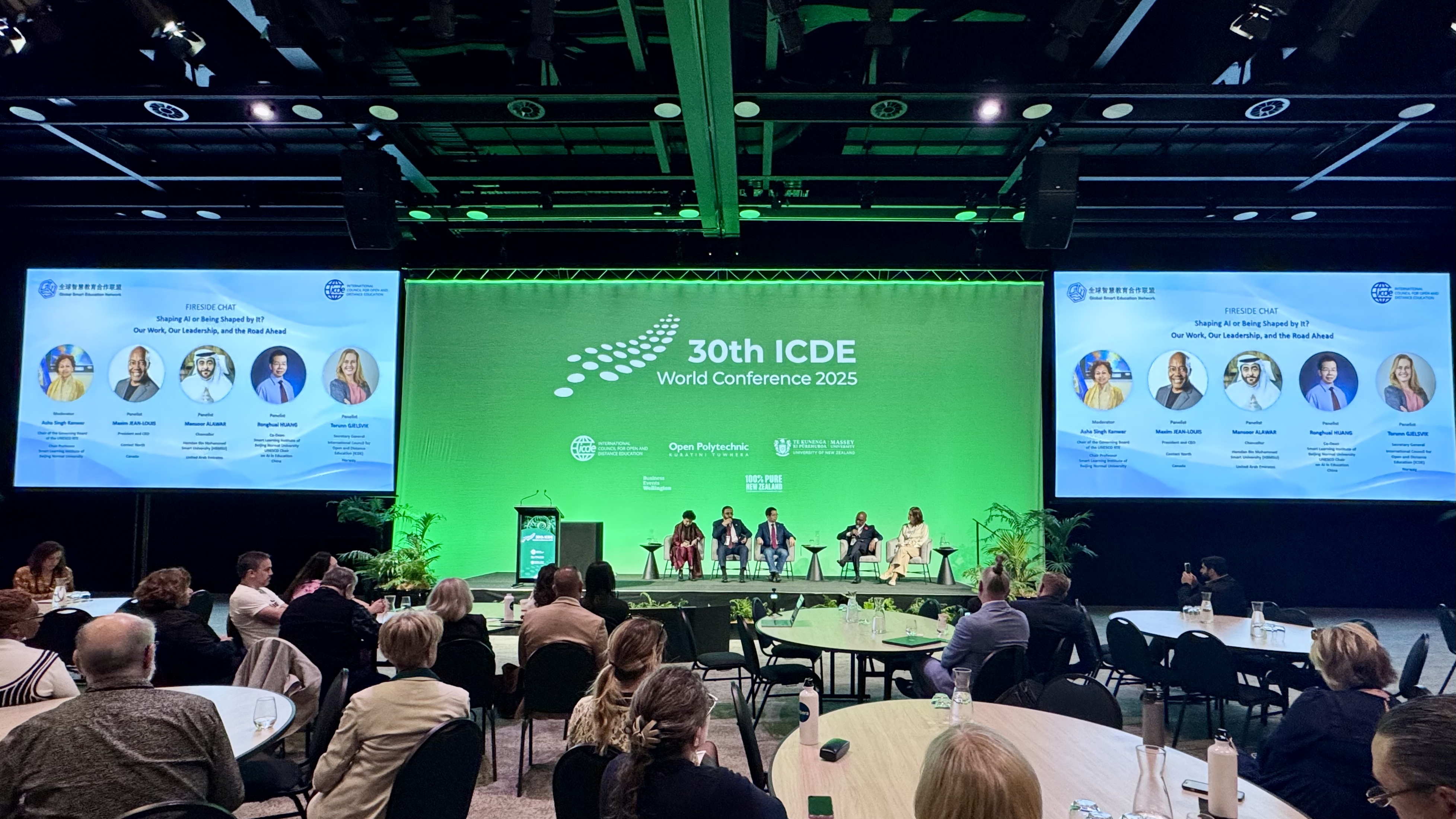
Fireside Chat Hosted by GSENet
During the conference, the Global Smart Education Network (GSENet), initiated by Beijing Normal University (BNU), hosted a Fireside Chat titled "Shaping AI or Being Shaped by It? Our Work, Our Leadership, and the Road Ahead" as part of the plenary programme. The session was chaired by Prof. Asha Singh Kanwar, Chair of the Governing Board of the UNESCO Institute for Information Technologies in Education (UNESCO IITE) and Chair Professor at the Smart Learning Institute of BNU. Panelists included Dr. Mansoor Alawar, Chancellor of Hamdan Bin Mohammed Smart University, United Arab Emirates; Mr. Maxim Jean-Louis, President and CEO of Contact North, Canada; Ms. Torunn Gjelsvik, Secretary General of ICDE; and Prof. Huang Ronghuai, Co-Dean of the Smart Learning Institute of BNU and UNESCO Chair on AI in Education.
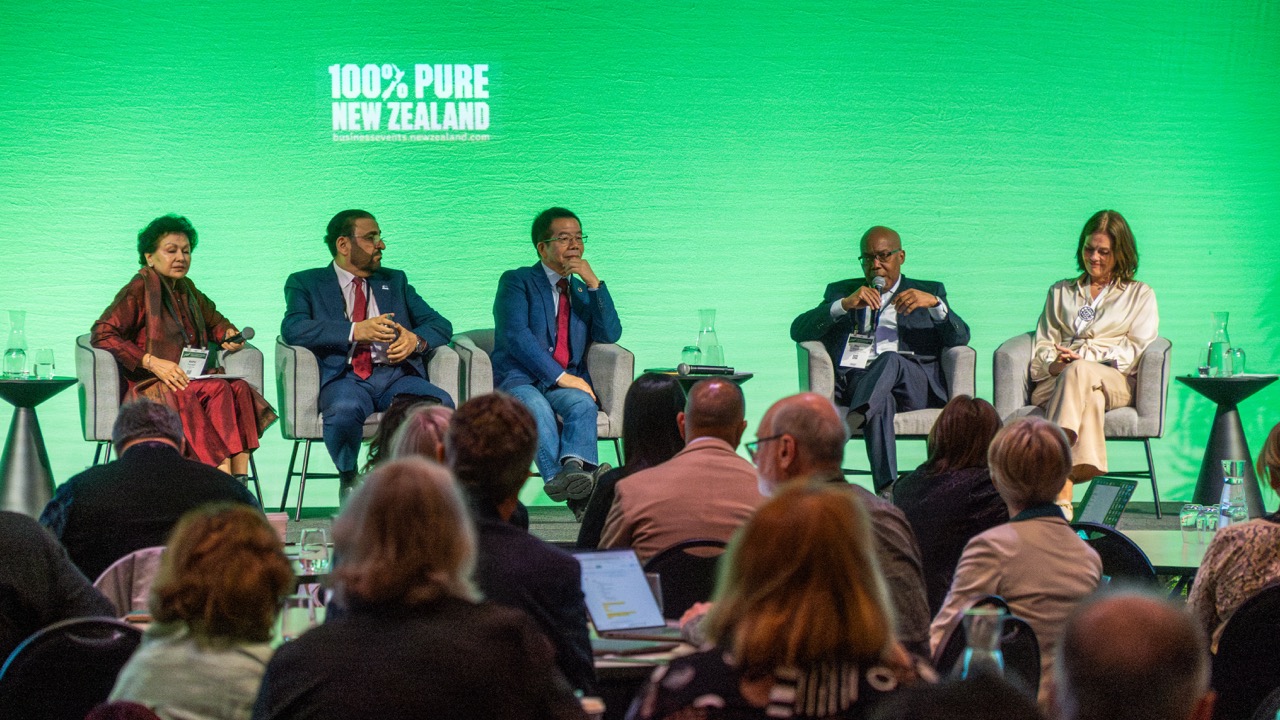
The Panelists Engaged in In-Depth Discussion
The speakers engaged in an in-depth discussion on the role of artificial intelligence in education, institutional governance, and the transformation of research paradigms, sharing practical experiences and strategic reflections from diverse regional and institutional contexts.
In the opening remarks, Prof. Asha Singh Kanwar highlighted both the opportunities and emerging risks brought by rapidly advancing AI technologies, including digital divides, gender bias, and issues of cultural relevance. She emphasized that AI, created by humans yet profoundly shaping how we think, learn, and organize societies, demands responsible, ethical, inclusive, and transparent use. Educational leaders, she noted, must ensure that human-centred values are upheld and that innovation is aligned with equity and inclusion.
Dr. Mansoor Alawar underscored that academic integrity, teacher empowerment, and equity must guide institutional adoption of AI. He shared experiences from Hamdan Bin Mohammed Smart University’s implementation of “AI teaching assistants,” which have significantly reduced repetitive tasks and improved instructional efficiency. He stressed the importance of simple governance frameworks, rapid support mechanisms, and a collaborative learning culture to enable AI to contribute to more personalized, data-driven, and equitable learning.
Prof. Huang Ronghuai emphasized that educational transformation in the AI era should be grounded in the Science of Learning and adapted to local and regional contexts. He presented China’s practices in integrating AI into writing instruction in basic education, demonstrating AI’s potential to stimulate creativity and improve learning outcomes. He encouraged educators to move beyond the “AI toolkit mindset” and foster human–AI synergy, maintaining ethical vigilance and prioritizing learner agency. Prof. Huang invited global partners to join GSENet in advancing smart education worldwide.
Mr. Maxim Jean-Louis stressed that learners must not become mere “prompt generators,” urging institutions to prioritise simplicity, privacy, and openness in AI adoption. He called for the development of locally relevant AI tools to ensure data protection and contextual accuracy. He also introduced the concept of “chaos adoption,” advocating for an exploratory and experimental approach to discovering the potential of AI in education, supported by continuous sharing of best practices.
Ms. Torunn Gjelsvik highlighted the essential role of cooperation and co-creation in meeting the opportunities and challenges of AI in education. Using the metaphor of a choir, she emphasized that “every voice is unique and important,” and only through coordinated collaboration can meaningful progress be achieved. She also noted the sustainability implications of AI, referencing the conclusions of ICDE’s Ethical Leadership Summit in Geneva, which likened AI to “a charging elephant”—something the education sector must learn to guide collectively and responsibly.
The panelists’ insightful perspectives resonated strongly with participants, sparking extensive discussion and follow-up exchanges after the session.
About GSENet
Established in 2022 by BNU, UNESCO IITE, the International Society for Technology in Education (ISTE), the Arab League Educational, Cultural and Scientific Organization (ALECSO), the Southeast Asian Ministers of Education Organization (SEAMEO), and the Commonwealth of Learning (COL), the Global Smart Education Network (GSENet) has grown to 21 member institutions across major world regions. Each member plays a significant role in advancing smart and digital education in its respective region.
GSENet regularly organizes academic activities such as the Smart Education Webinar Series, Regional High-Level Dialogues, and publishes the Global Smart Education Report. Its annual Global Smart Education Conference (GSE)has become a flagship international event with wide global visibility and influence.