

BNU Team Makes Breakthrough in Studying Supermassive Black Holes at Cosmic Dawn
A research team led by Professor Xingjiang Zhu from the Faculty of Arts and Sciences and the Institute for Frontiers in Astronomy and Astrophysics at Beijing Normal University (BNU), in collaboration with the Parkes Pulsar Timing Array (PPTA) collaboration, has made significant progress in using pulsar timing arrays to detect supermassive binary black holes in the early Universe.

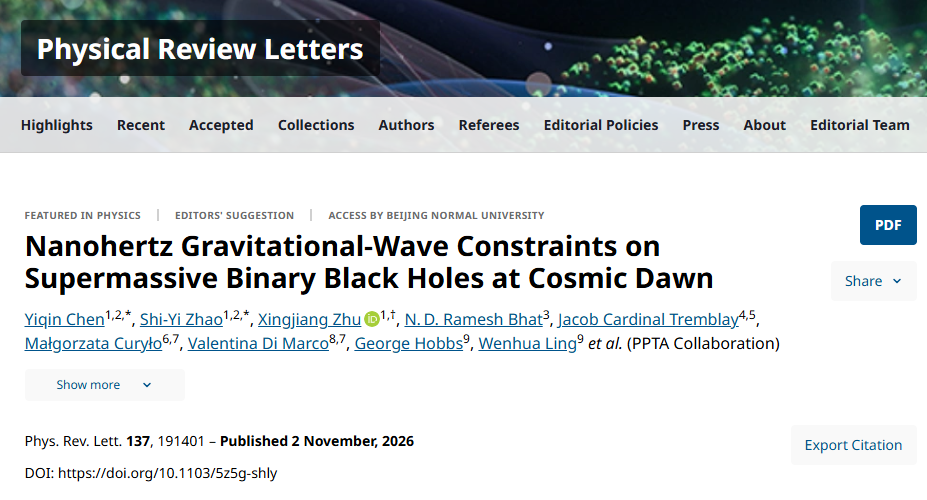
The findings, published on November 2 in Physical Review Letters under the title "Nanohertz Gravitational-Wave Constraints on Supermassive Binary Black Holes at Cosmic Dawn," were selected as an Editors' Suggestion and featured on the website of the American Physical Society (APS).
Recent observations by the James Webb Space Telescope (JWST) and other astronomical facilities have revealed massive galaxies and supermassive black holes in the early Universe. These discoveries pose significant challenges to existing astrophysical theories: How did black holes form and grow to masses of up to tens of billions of solar masses within just a few hundred million years after the Big Bang? Answering this question requires new observational tools for probing the era known as cosmic dawn.

Gravitational waves emitted by binary black holes at cosmic dawn as detected by a pulsar timing array (Image credit: OzGrav/Swinburn/Carl/Knox)
To address this question, the research team developed a continuous gravitational-wave analysis framework for pulsar timing arrays that accounts for cosmological redshift effects. They applied the framework to the third data release of the Parkes Pulsar Timing Array (PPTA DR3), which spans approximately 18 years of observations. This marks the first time that actual observational data have been used to place direct constraints on supermassive binary black holes at cosmic dawn.
The team focused on two representative high-redshift objects: the ultraluminous quasar J0100+2802, at a redshift of 6.327, and the JWST-discovered galaxy JADES-GS-z14-0, at a redshift of 14.32.
The analysis shows that existing PPTA data can already place meaningful constraints on high-redshift binary black hole systems with masses above approximately 10 billion solar masses in the nanohertz frequency band.
Notably, the study observationally demonstrated a theoretically predicted effect known as "redshift bias." Due to the combined effects of cosmological redshift and binary black hole evolution, the sensitivity of pulsar timing arrays to these systems does not simply decrease with increasing distance. This makes nanohertz gravitational waves a potentially powerful tool for probing the distant early Universe and opens new possibilities for observing cosmic dawn.
Further simulations suggest that recovering gravitational-wave phase coherence using a small number of pulsars with precisely measured distances could improve the sky-localization accuracy of high-redshift binary black hole signals by a factor of 30.
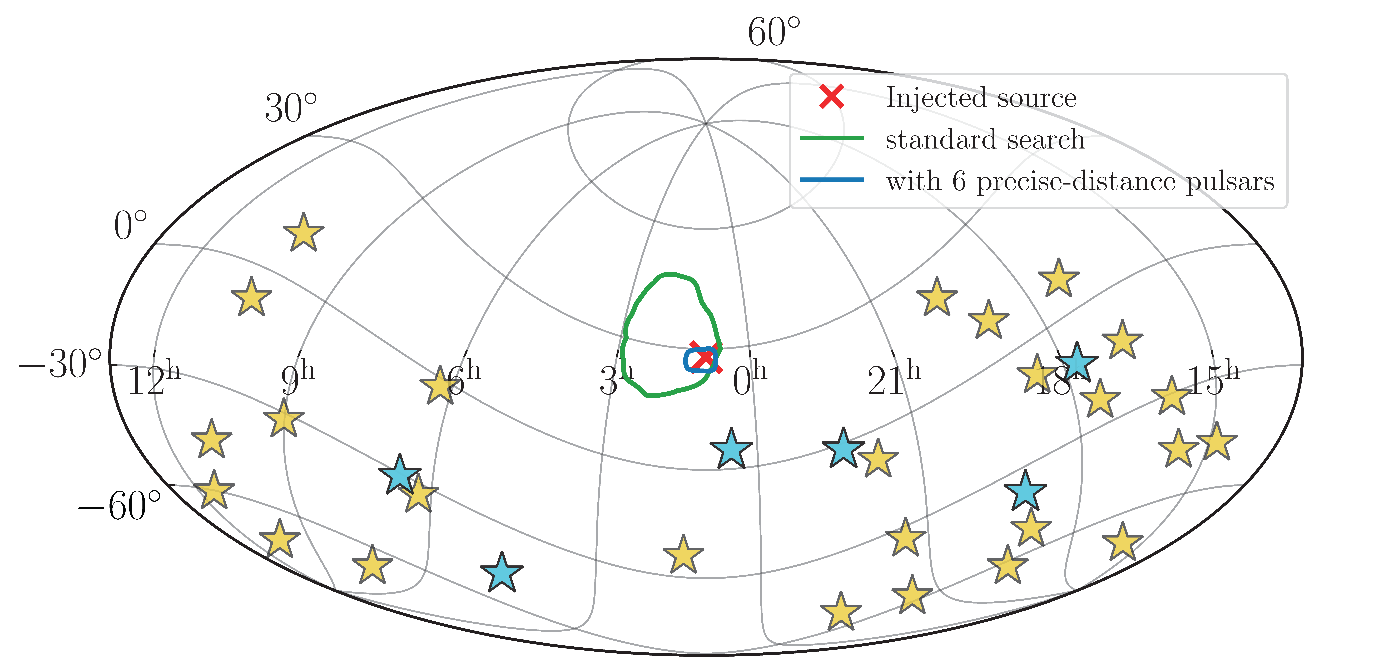
Improved sky localization of high-redshift binary black holes using a small number of pulsars with highly precise distance measurements.
Chen Yiqin and Zhao Shiyi, doctoral students at BNU's Zhuhai Campus, are co-first authors of the paper, and Professor Zhu Xingjiang is the corresponding author.
The study extends pulsar timing array investigations of individual supermassive binary black holes from the local Universe to cosmic dawn. It also provides a new gravitational-wave observational approach for future studies that combine data from facilities such as JWST and the Square Kilometre Array (SKA) to investigate the formation, growth, and merger history of early supermassive black holes. The findings offer new opportunities to understand the formation and evolution of structures in the early Universe.
Read the paper: https://journals.aps.org/prl/abstract/10.1103/5z5g-shly