

Professor Miao Chiyuan from the Faculty of Geographical Science published three papers in Nature Climate Change, Nature Communications, and Proceedings of the National Academy of Sciences
Against the backdrop of global warming profoundly reshaping the hydrological cycle, water resource security faces unprecedented systemic challenges. Recently, Professor Miao Chi-yuan's research team from the Faculty of Geographical Science at Beijing Normal University has published significant findings in three major international academic journals: Nature Climate Change, Nature Communications, and Proceedings of the National Academy of Sciences. Through systematic analysis of three critical aspects—model calibration, novel disaster mechanisms, and combined human-climate stress assessments—the team has elucidated the cascading characteristics and underlying mechanisms of water crises under climate change, providing robust scientific evidence for addressing global and regional water security risks.
1. Constrained Earth system models show a stronger reduction in future Northern Hemisphere snowmelt water
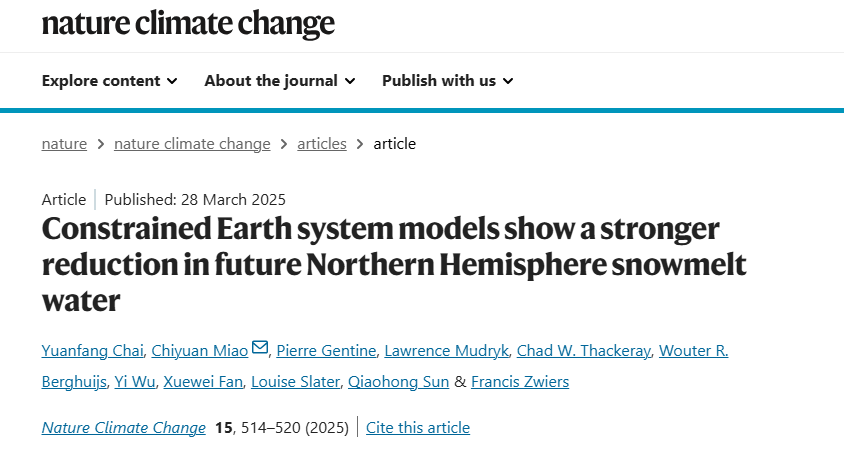
The abstract of this paper is as follows:
Although Earth system models (ESMs) tend to overestimate historical land surface warming, they also overestimate snow amounts in the Northern Hemisphere. By combining ground-based datasets and ESMs, we find that this paradoxical phenomenon is predominantly driven by an overestimation of light snowfall frequency. Using spatially distributed emergent constraints, we show that this paradox persists in mid- (2041–2060) and long-term (2081–2100) projections, affecting more than half of the Northern Hemisphere’s land surface. ESMs underestimate the frequency of freezing days by 12–19% and overestimate snow water equivalent by 28–34%. Constrained projections indicate that the raw ESM outputs overestimate future Northern Hemisphere snowmelt water by 12–16% across 53–60% of the Northern Hemisphere’s land surface. This snowmelt water overprediction implies that the amount of water available in the future for agriculture, industry, ecosystems and domestic use may be lower than unadjusted ESM projections suggest.
Reference:https://www.nature.com/articles/s41558-025-02308-y
2. Flash droughts exacerbate global vegetation loss and delay recovery
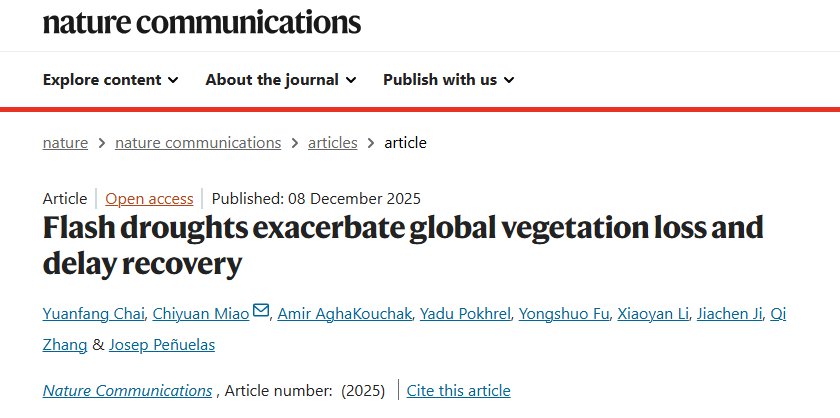
The abstract of this paper is as follows:
The increasing incidence of flash droughts globally presents a great challenge to the agriculture sector, ecosystem resilience and water resource systems. Here we introduce a methodology that improves the accuracy of quantifying drought-induced global vegetation loss (using Normalized Difference Vegetation Index (NDVI)-derived metric). Our results reveal that NDVI loss during flash droughts (9.0%) is approximately 1.5 times higher than that during conventional droughts (5.3%), highlighting the increasing role of flash droughts as the key driver of drought-induced NDVI loss worldwide. Furthermore, we identify a significant upward trend (1.8% per decade) in global NDVI loss due to flash droughts, primarily driven by the increasing frequency of such events, which account for 81.2% of the overall trend. Although NDVI typically recovers within 36 pentads across more than 9256.3 × 104 km2 of the global land surface after flash droughts, there is a notable increase (0.4 pentads per year) in NDVI recovery time from 1982 to 2020, particularly in tropical rainforests and temperate forests. These findings highlight the alarming ecological consequences of increasingly frequent and intense flash droughts, with impacts expected to intensify in the future.
Reference: https://www.nature.com/articles/s41467-025-67173-x
3. Warming climate and water withdrawals threaten river flow connectivity in China
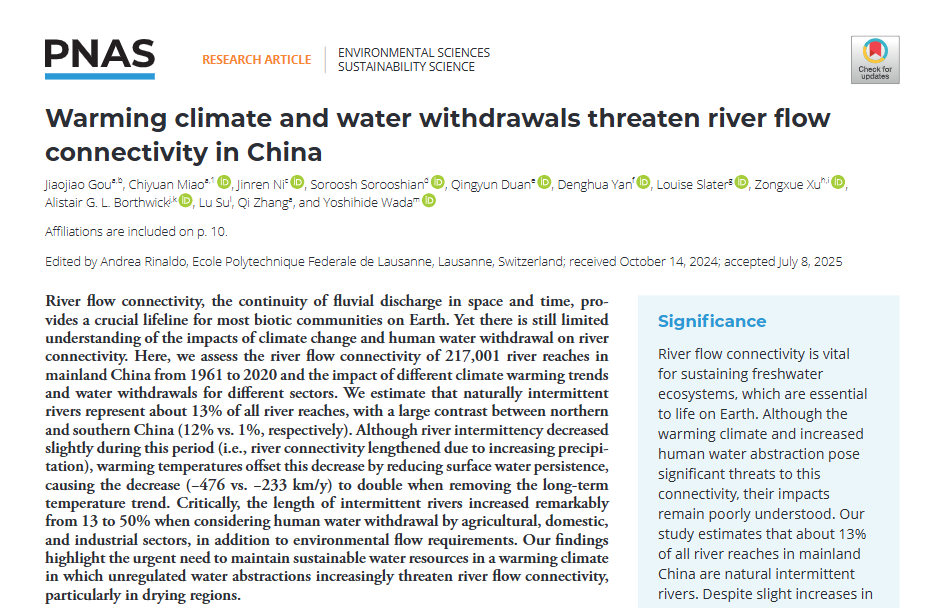
The abstract of this paper is as follows:
River flow connectivity, the continuity of fluvial discharge in space and time, provides a crucial lifeline for most biotic communities on Earth. Yet there is still limited understanding of the impacts of climate change and human water withdrawal on river connectivity. Here, we assess the river flow connectivity of 217,001 river reaches in mainland China from 1961 to 2020 and the impact of different climate warming trends and water withdrawals for different sectors. We estimate that naturally intermittent rivers represent about 13% of all river reaches, with a large contrast between northern and southern China (12% vs. 1%, respectively). Although river intermittency decreased slightly during this period (i.e., river connectivity lengthened due to increasing precipitation), warming temperatures offset this decrease by reducing surface water persistence, causing the decrease (−476 vs. −233 km/y) to double when removing the long-term temperature trend. Critically, the length of intermittent rivers increased remarkably from 13 to 50% when considering human water withdrawal by agricultural, domestic, and industrial sectors, in addition to environmental flow requirements. Our findings highlight the urgent need to maintain sustainable water resources in a warming climate in which unregulated water abstractions increasingly threaten river flow connectivity, particularly in drying regions.
Reference: https://www.pnas.org/doi/abs/10.1073/pnas.2421046122