

Liu He's Team at the Faculty of Arts and Sciences Published a Paper in PNAS
On September 23, a team led by Liu He, a research professor in the Department of Systems Science, Faculty of Arts and Sciences, Beijing Normal University(BNU), published a research paper titled "A push–pull gut–brain signal regulates flexible learning in Caenorhabditis elegans" in the international journal PNAS. The study reveals a push–pull mechanism by which a gut-derived neuropeptide regulates learning speed through antagonistic receptors, offering a new mechanistic framework for understanding how internal physiological states drive flexible learning and adaptive behavior.
Abstract
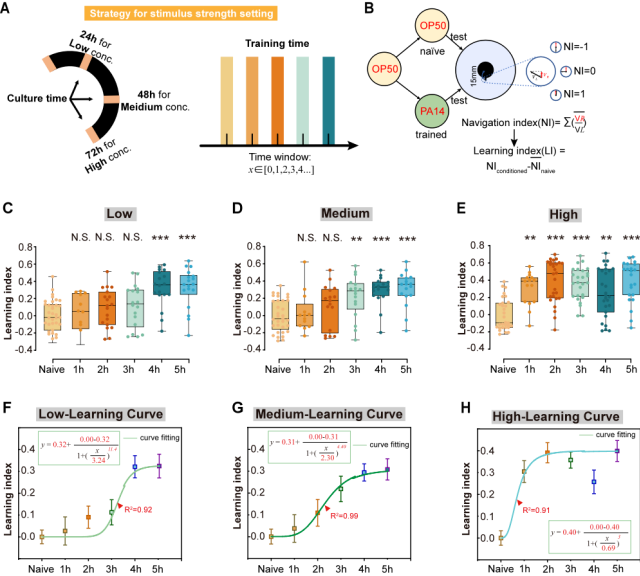
Animals must flexibly adjust their learning strategies to cope with changing environmental threats. In Caenorhabditis elegans, exposure to the pathogenic bacterium Pseudomonas aeruginosa (PA14) induces aversive learning, and we uncover that the shape of learning curves varies with the virulence of the pathogen. This flexibility is governed by a gut-to-brain neuropeptide signaling pathway that modulates learning dynamics in response to internal physiological state. PA14 exposure upregulates the intestinal neuropeptide FLP-18, which acts on two antagonistic receptors, NPR-5 and NPR-6, in the ADF sensory neurons. NPR-5 promotes ADF activity and accelerates learning, whereas NPR-6 dampens ADF responses and slows learning. Through behavioral assays, calcium imaging, and genetic perturbations, we show that the dynamic balance between these receptor pathways tunes ADF activity and learning progression according to pathogen virulence. Finally, we develop a mathematical model incorporating pathogen intake, FLP-18 dynamics, receptor interactions, and ADF activity, which quantitatively captures the modulation of learning behavior across virulence levels. Together, our findings reveal a push–pull signaling mechanism within the gut–brain axis that translates internal state into flexible behavioral adaptation.