

Professor Genban Sun's Team from the College of Chemistry Publishes Significant Findings in Angewandte Chemie International Edition
Recently, the team led by Professor Sun Genban from the College of Chemistry Published their significant findings titled "Toward Practical Ultralong-Life Li-Air Batteries in High-Humidity Environments: A Synergistic Strategy for Dual-Interfacial Engineering" in Angewandte Chemie International Edition.
The abstract of this paper is as follows:
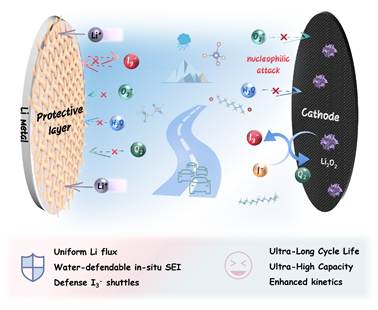
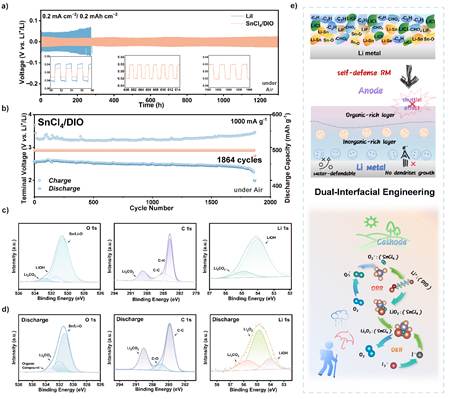
Maintaining the operational stability of Li–air batteries (LABs) in high-humidity environments is crucial for their transition from laboratory research to practical deployment. Herein, we propose a synergistic strategy for dual-interfacial engineering toward ultralong-life LABs in high-humidity environments. An iodine-based self-defense redox mediator—SnCl4 and 1,8-diiodooctane (DIO) is introduced into the electrolyte. On the cathode side, it enabled efficient bidirectional OER/ORR catalysis while forming a protective interface that suppressed both nucleophilic and hydrolytic attack. On the anode side, a highly lithiophilic, corrosion-resistant, and moisture-tolerant protective layer forms on the Li anode, which ensures stable battery operation under extremely humid conditions. The results show that the Li─O2 battery achieved more than 2400 cycles (nearly 3000 h) at 1000 mA g−1 and an extremely low charge potential (<3.5 V), coupled with a high discharge capacity of 111879 mAh g−1. Notably, the SnCl4/DIO-based LABs reached more than 1800 cycles (>2160 h) even in atmospheric air without humidity control. This work significantly overcomes the strict humidity limits of traditional LABs and provides an innovative strategy for developing LABs capable of operating in high-humidity environments.
Reference: https://onlinelibrary.wiley.com/doi/10.1002/anie.202523411