

Professor Miao Chiyuan's Team from the Faculty of Geographical Science Published a Paper in Nature Reviews Earth & Environment
Drought is a major natural hazard affecting food security, water resources, and ecosystem stability. Traditionally, drought has been regarded as being driven mainly by precipitation deficits. However, under global warming, increasing atmospheric evaporative demand is fundamentally reshaping drought formation mechanisms. In 2025, global land surface temperature reached its third-highest level on record, substantially intensifying evapotranspiration demand. As a result, many regions experienced severe drought even where precipitation deficits were not extreme.
Recently, the research team led by Professor Miao Chiyuan from the Faculty of Geographical Science at Beijing Normal University carried out a study on extreme global drought events in 2025, systematically revealing the spatiotemporal patterns, regional hotspots, and underlying mechanisms of drought during that year. The related work, entitled "Global drought extremes in 2025" was published in April 2026 in Nature Reviews Earth & Environment.
The Summary of the paper is as follows:
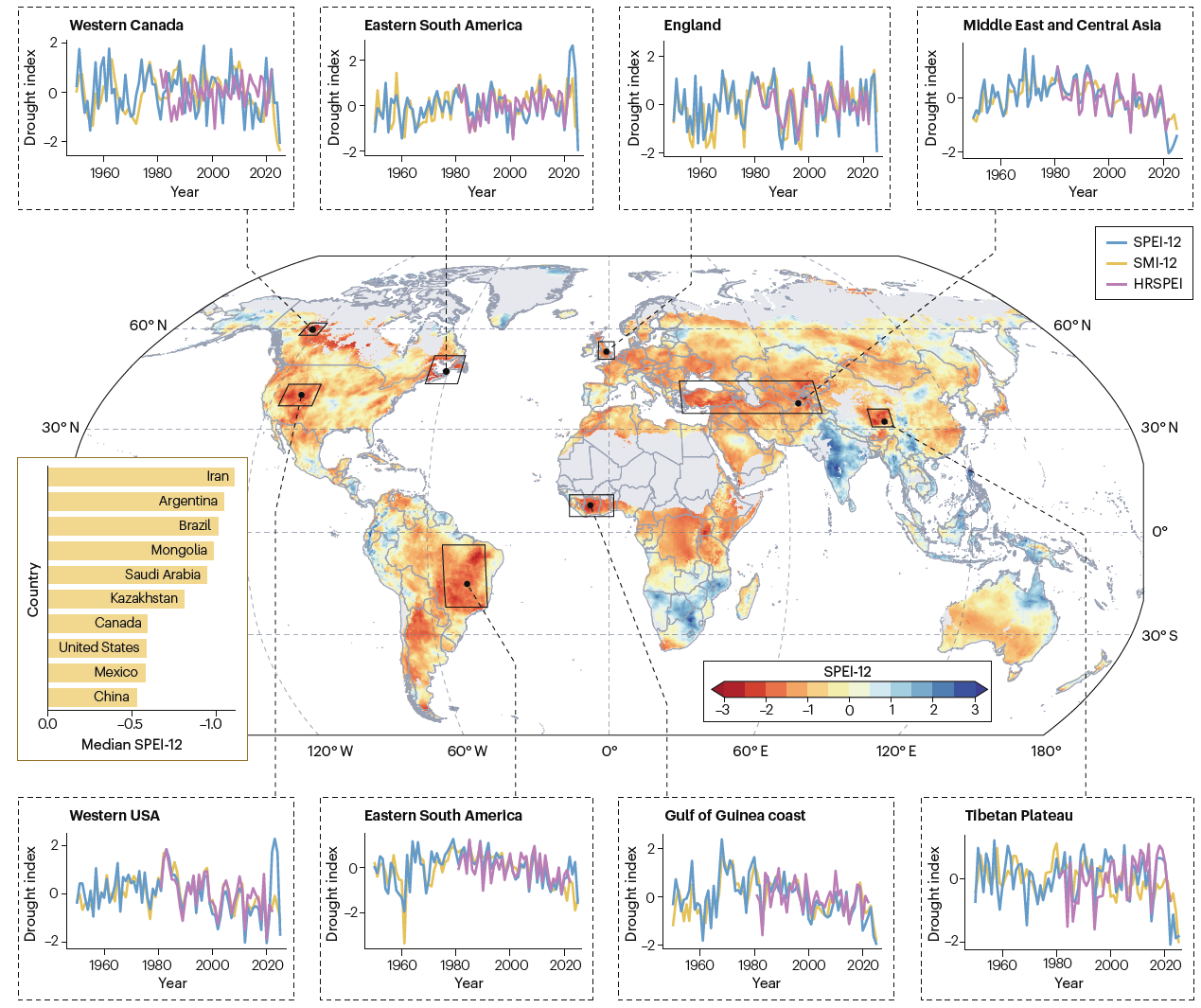
Drought affected ~30% of the global land surface in 2025 and has been increasingly driven by thermodynamic forcing and not solely by precipitation deficits, marking a pivotal point. Near-record land warming intensified evaporative demand, pushing several regions into severe drought even under moderate precipitation anomalies. In addition, the near - 'Day Zero' water emergency in Tehran illustrates how rapidly extreme drought can impact large urban systems.
The spatial patterns observed in 2025, from weakened moisture recycling in the Amazon and West Africa to destabilized cryospheric 'water towers' in Asia and compound heat-drought extremes in mid-latitudes, underscore a fundamental shift towards evaporative demand-driven drought. Under continued warming, drought risk will increasingly depend on temperature-mediated land–atmosphere feedbacks. Therefore, we predict that adaptation strategies will need to address not only precipitation variability but also rising atmospheric thirst, soil moisture resilience, and land-use–climate interactions.
Reference: https://doi.org/10.1038/s43017-026-00785-z