

Dou Fei's Team from College of Life Sciences Published a Paper in Journal of Controlled Release
On March 11, the research team led by Dou Fei from College of Life Sciences, in collaboration with the team led by Lu Zhonglin from College of Chemistry, published a research article online in Journal of Controlled Release. Entitled "Lipid nanocomposites for precisely triggered Ttc3gene silencing in pulmonary fibrosis treatment", the paper systematically elucidates the pivotal role of the Ttc3 gene in the pathogenesis and progression of pulmonary fibrosis. It also presents a novel siRNA lipid-based nano-delivery system, offering new insights and a promising strategy for the treatment of idiopathic pulmonary fibrosis.
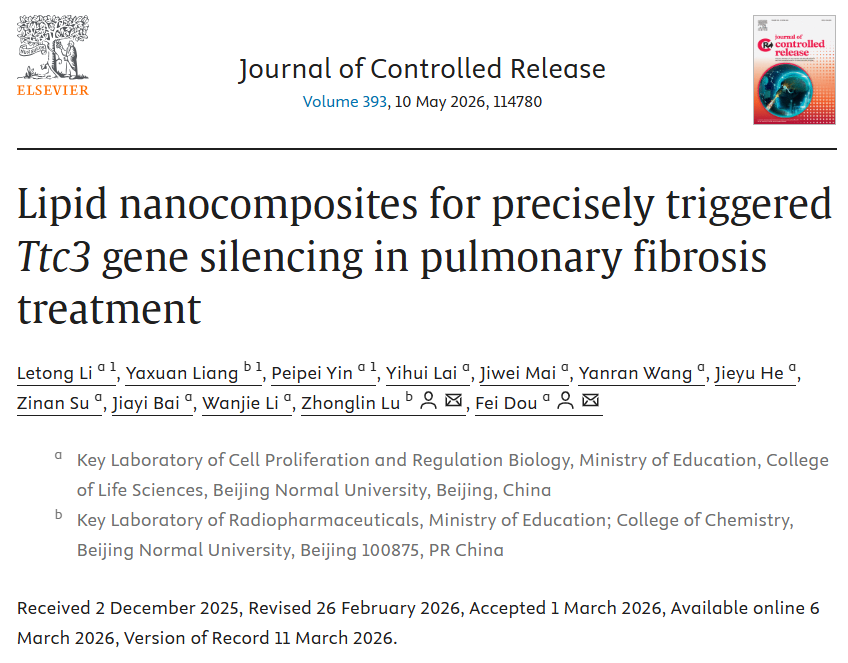
The abstract of this paper is as follows:
Idiopathic pulmonary fibrosis (IPF) is a fatal respiratory disorder with limited therapeutic options. The tetratricopeptide repeat domain 3 (TTC3) gene, located on chromosome 21, has poorly defined biological functions. By generating Ttc3 knockout mice, we found that lacking Ttc3 led to severe pulmonary development defects after birth, indicating its essential role in lung homeostasis. In this study, we identified Ttc3 as a critical regulator in the progression of pulmonary fibrosis by activating the PI3K/Akt signaling pathway, suggesting that Ttc3 might be a potential target for IPF treatment. Here, we developed a lipid–polymer hybrid nanocarrier (TMD) engineered to encapsulate and control release of small interfering RNA (siRNA), and demonstrated that the TMD exhibited optimal particle size and improved structural stability, high biocompatibility, and efficient transfection efficiency in lung tissue. In the bleomycin (BLM)-induced pulmonary fibrosis mouse model, siTtc3@TMD effectively knocked down Ttc3 expression in lung tissue, significantly inhibited the activation of PI3K/Akt signaling pathway, mitigated lung tissue pathological damage, preserved pulmonary function, and ultimately alleviated pulmonary fibrosis. In summary, our study highlights both a novel therapeutic target (Ttc3) and a safe, efficient siRNA delivery platform, providing a promising strategy for the treatment of pulmonary fibrosis.
Reference: https://www.sciencedirect.com/science/article/pii/S0168365926001823?via%3Dihub