

Professor Yuan Fanglong's Research Group from the College of Chemistry Published Important Results in Angewandte Chemie International Edition
A research group led by Professor Yuan Fanglong from the College of Chemistry has published a significant paper in Angewandte Chemie International Edition, titled Helical Nanoconfinement in Recyclable Chiral Soft Photonic Crystals Enables Strong and Efficient Full-Color Circularly Polarized Luminescence From Carbon Quantum Dots.
The abstracts of the paper is as follows:
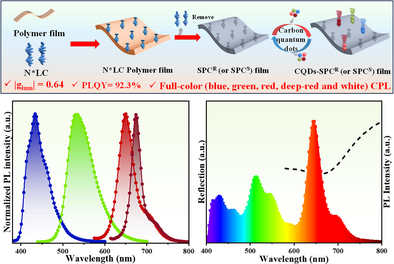
Circularly polarized luminescence (CPL) materials typically suffer from a fundamental trade-off between the luminescence dissymmetry factors (glum) and photoluminescence quantum yields (PLQYs), which severely limit their practical implementation. Here, we exploit helical nanoconfinement within a recyclable chiral soft photonic crystal (SPC) to break this trade-off, achieving, for the first time, strong, and efficient full-color CPL from a series of environmentally friendly achiral carbon quantum dots (CQDs). The SPC films retain a three-dimensional helical nanopore network inherited from a chiral liquid-crystal template. This long-range helical nanoconfinement simultaneously imparts strong chiroptical activity to the embedded CQDs and suppresses their aggregation-caused quenching. Consequently, blue-, green-, red-, and deep-red-emissive CQD@SPC composites exhibit high |glum| values up to 0.48 together with exceptional PLQYs of up to 92% across the visible spectrum. The SPC host is fully recyclable, maintaining its chiral nanostructure and CPL performance over multiple loading-elution cycles. Moreover, integrating blue-, green-, and red-emissive CQDs within the SPC produces white-light CPL with a record-high |glum| of 0.64, and the platform simultaneously accommodates multilevel optical encryption functionalities. This work establishes helical nanoconfinement in recyclable SPCs as a versatile solid-state strategy for generating high-performance CPL from environmentally friendly CQDs, opening avenues toward advanced chiroptical technologies.
Reference: https://onlinelibrary.wiley.com/doi/10.1002/anie.4885590