

Professor Chen Lei's Team from the School of Environment Published a Study in npj Clean Water
Recently, Professor Chen Lei’s team from the School of Environment at Beijing Normal University published a paper in npj Clean Water. The study was conducted in collaboration with researchers from the Research Center for Eco-Environmental Sciences of the Chinese Academy of Sciences, Zhejiang University, and other institutions. Titled "Machine learning reveals disruptive nutrient pollution shifts in Chinese rivers to 2100," the paper suggests that strategic land-use planning could be a cornerstone of future water security.
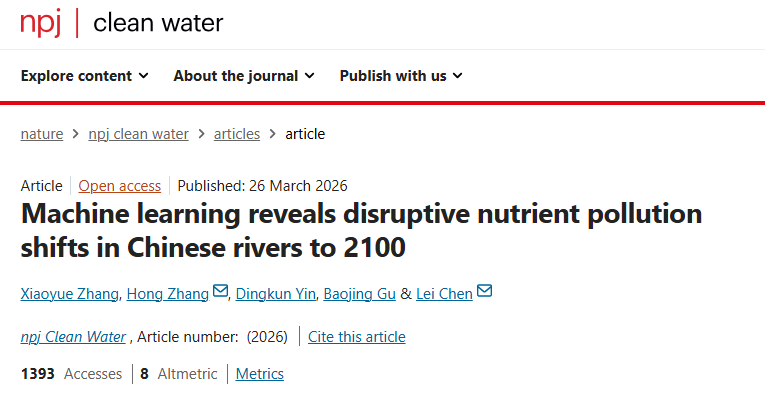
The abstract of this paper is as follows:
Anticipating nutrient pollution under changing conditions is urgent for water security. Nonetheless, high-resolution predictive frameworks capturing nonlinear driver responses remain limited. Here, we present a nationwide assessment of China’s water-quality evolution from 2023 to 2100, integrating over 3 million daily records with 41 climatic, landscape, and socioeconomic drivers via regionally tailored Random Forest models (R2 of 0.88–0.92). Our results reveal a disruptive spatiotemporal shift, with projected NPI ranges from –50.9% to +218.1% under SSP5-8.5. Seasonal patterns restructure toward unimodal peaks, with pollution increases in spring/autumn (up to 28.3%) but decreases in summer (up to 27.0%). Spatial homogenization emerges via a westward/southward shift of pollution centers, with localized increases exceeding 200% from coldspots with low baselines (<0.4 vs="">1.0 in hotspots). Landscape configuration dominates (64.5% feature importance) over climatic forcing (7.2%–35.5%), reinforced by minimal climatic projection uncertainty. Strategic land-use planning could be a cornerstone of future water security.
Reference:https://www.nature.com/articles/s41545-026-00571-w