

Professor Cui Zhen's Team from the School of Artificial Intelligence Published a Paper in Nature Machine Intelligence
Recently, Professor Cui Zhen's team from the School of Artificial Intelligence published a research paper titled "Two-Dimensional Geometric Template Diffusion for Boosting Single-Sequence Protein Structure Prediction" online in Nature Machine Intelligence. The team first summarize the framework of the proposed TDFold, a protein structure prediction model based on the proposed 2D geometric template diffusion model. Then, they conduct comprehensive experiments on multiple popular protein datasets, including Orphan, Orphan25, CASP14, CASP15 and CASP16. Finally, they analyse the effectiveness of each module in TDFold in the ablation study.
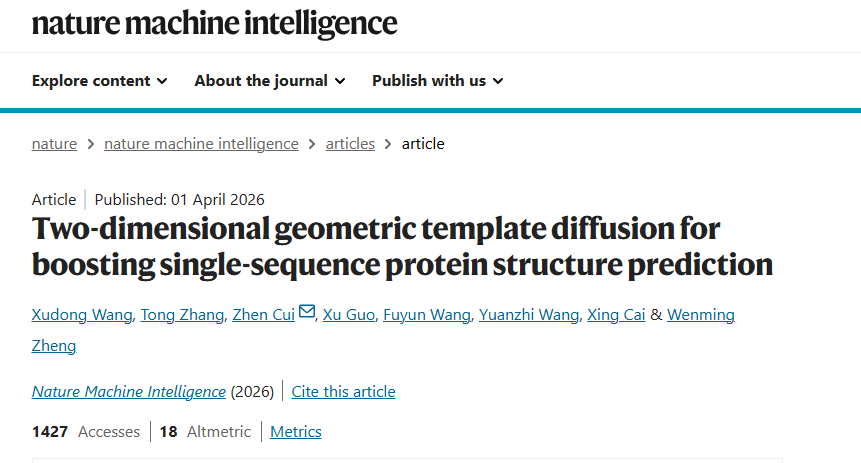
The abstract is as follows:
Protein structure prediction from a single sequence has drawn increasing attention due to the high computational costs associated with obtaining homologous information. Here we propose a two-dimensional geometric template diffusion method, named TDFold, to generate high-quality pairwise geometries (including pairwise distances and orientations). These are subsequently used for accurate and highly efficient three-dimensional protein structure prediction. Given a protein sequence, TDFold infers three-dimensional structure via a network architecture consisting of two stages: two-dimensional geometric template generation and sequence-geometry collaborative learning. TDFold presents three key advantages compared with existing protein language models (for example, ESMFold and OmegaFold) and homology-based methods (for example, AlphaFold2, AlphaFold3 and RoseTTAFold): better single-sequence-based prediction performance, lower resource consumption and higher efficiency in inference. This work demonstrates the model effectiveness on homology-insufficient datasets such as Orphan and Orphan25 and popular CASP benchmarks, introducing an alternative solution for single-sequence protein structure prediction. It also accelerates protein-related research, particularly for resource-limited universities and academic institutions.
Reference: https://www.nature.com/articles/s42256-026-01210-2