

Global Excellent Cases of Future Education Design Published: Youth Creativity Shapes the Future of Educational Innovation
Recently, the English case collection Empowering Educational Innovation Through Design: Best Practices from University Students, edited by experts from institutions including Beijing Normal University and published by the world-renowned Springer, has been officially released. Compiling outstanding works from the "Global Competition on Design for Future Education", the book aggregates the wisdom of young students from China, Serbia, Tunisia, the Maldives, and other countries, responding to global educational transformation challenges through design thinking. Meanwhile, as a key annual event of the "World Digital Education Alliance," the competition has been fully upgraded to the Global Competition on Design for Futures and launched in January 2026, expanding its scope to sustainable development fields. It stands as a vivid practice of implementing UNESCO's educational development initiatives and China's educational digitalization strategy.
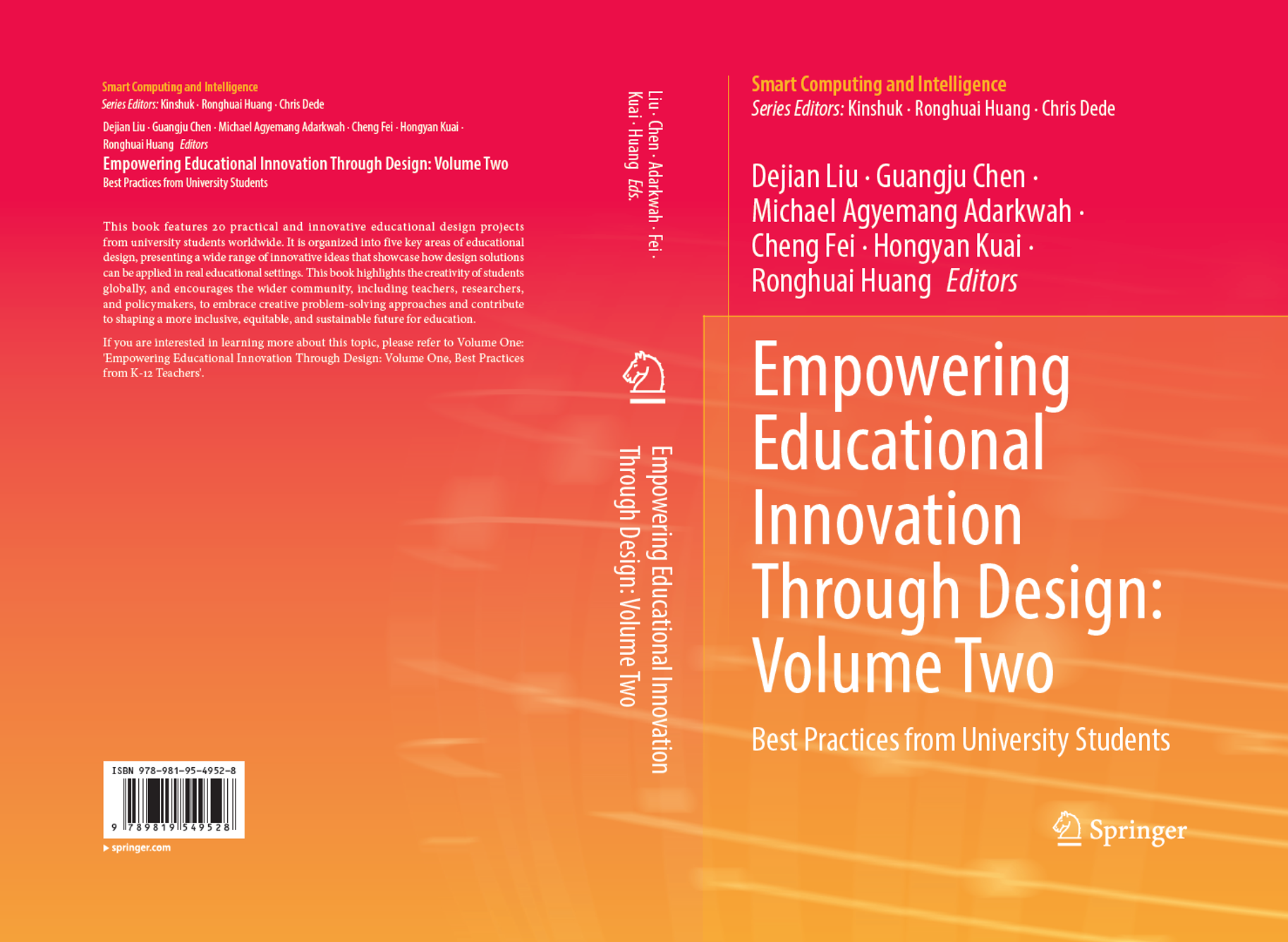
Figure: Cover of Empowering Educational Innovation Through Design: Best Practices from University Students*
Co-hosted by Beijing Normal University and UNESCO's Institute for Information Technologies in Education, the "Global Competition on Design for Future Education" has been successfully held for eight editions since its launch in 2018. Attracting tens of thousands of university students from over 40 countries and regions worldwide, it has evolved into an internationally influential platform for educational innovation exchange. The newly published case collection is carefully selected from the competition's outstanding works over the years. Professor Ronghuai HUANG, co-dean of the Smart Learning Institute at Beijing Normal University and editor-in-chief of the book, proposes that educational design encompasses five types: product design, solution design, service design, mechanism design, and policy design. This collection focuses on three core categories-product, solution, and service design-centering on key global educational development issues such as special education, rural education, and cultural heritage inheritance, laying a solid practical and creative foundation for the upgraded competition.
Currently, global education is at a critical turning point. Responding to global consensus, The 2024-2035 Master Plan on Building China into a Leading Country in Education explicitly advocates for artificial intelligence to empower educational reform. The publication of the case collection and the competition's upgrade are concrete practices of this strategy.
Design Thinking as the Core: Constructing a Scientific and Innovative Practical Path
Dr. Dejian Liu, part-time professor at Beijing Normal University, chairman of NetDragon, and editor-in-chief of the book, has long been engaged in the design field. He advocates that "everything can be designed" and has developed a unique Design Methodology with his team. This methodology covers multiple links including original demand analysis, target user analysis, stakeholder analysis, scenario analysis, and competitor analysis. Serving not only as an innovative tool but also an effective process system, it helps designers clarify ideas, focus on pain points, and solve practical problems through systematic methods.
Beyond the Design Methodology, participants have creatively applied internationally classic design thinking models such as the Double Diamond Model, EDIPT Model, and 3I Model to address educational issues, exploring a scientific and systematic design practice path. From developing inclusive campus innovation solutions for deaf students to designing toys for children with ADHD, from building AIGC-powered independent learning platforms for intangible cultural heritage inheritance to creating intelligent learning empowerment systems for rural education—these innovative practices not only make design thinking flourish in the educational field but also accumulate rich experience for cross-domain innovation.
Technology for Good: Integrating Cutting-Edge Technology with Educational Scenarios
Closely following global digital development trends, the case collection adheres to the concept of "technology for good," deeply integrating cutting-edge technologies such as generative artificial intelligence, metaverse, big data, Internet of Things, and mixed reality with educational scenarios. It has created a series of "technology + education" innovative examples, enabling technology to truly become an important support for promoting educational equity and improving educational quality.
In case development, young students have demonstrated solid technological application capabilities and innovative thinking: The AIGC-based independent learning platform for digital Chinese opera revitalizes traditional intangible cultural heritage in the digital age; the Internet of Things and AI-driven personalized learning path recommendation system achieves precise adaptation to learning needs; the mixed reality-enabled immersive geography learning project breaks the temporal and spatial limitations of traditional classrooms. These explorations are highly aligned with UNESCO's concept of "adopting accessible, affordable, and easy-to-use digital technologies to enhance development inclusiveness."
More importantly, the upgraded Competition takes artificial intelligence technology as the core link, specially setting three major competition themes: AI for Science, AI for Education, and AI for Society. It aims to promote in-depth integration of technology with multiple fields, making technological innovation an important engine for sustainable development.
Global Youth Voices: Chinese Wisdom Demonstrating Innovative Strength
This case collection is a true "voice collection" of global young students—gathering university students from different countries and regions to share their keen insights into local development issues and beautiful visions for the future. Design solutions from around the world transcend national borders, cultures, and disciplines, reflecting the collective thinking and diverse responses of the younger generation to common development challenges.
A Serbian team explores the application of metaverse in local educational scenarios, providing regionalized solutions for educational digital transformation; a Maldivian team builds a rural education empowerment platform, focusing on balancing educational resources in island countries; a Croatian team develops an AI-supported application for protecting marginalized cultural heritage, enabling niche cultures to survive in the digital age.
Chinese students have also designed a series of solutions with both technological innovation and social value: from search assistant mini-programs tailored for the elderly to use smart devices, to digital solutions for inheriting traditional Chinese cultures such as Pu'er Tea, Wei County Paper-Cutting, She Silver Jewelry, and Glazed Ridge Beasts, and to multi-functional cultural exchange spaces designed for rural areas. These works fully demonstrate the innovative wisdom of Chinese students, becoming an important part of the global educational innovation landscape.
Multidimensional Value Highlighted: Building an Innovative Development Closed-Loop System
As a vivid sample of global innovative practices, this case collection not only condenses the exploration achievements of young students but also provides multiple practical values for college students' growth, university talent training, and social development, initially constructing an innovative closed loop of "youth practice-university talent cultivation-social application." The comprehensive upgrade of the Competition further expands the radiation scope and value boundary of this closed loop.
At the university level, the case collection offers important references for the reform of higher education talent training models. The works fully reflect the value of interdisciplinary integration-students from computer science, design, education, psychology, culture, and other majors collaborate, allowing knowledge from different disciplines to spark innovation in practical practice. It provides vivid cases for universities to promote interdisciplinary curriculum construction and practical teaching reform, and explores feasible paths for realizing the educational goal of "cultivating students' critical thinking, creative thinking, and practical thinking."
At the social level, the case collection provides abundant innovative solutions for solving various educational practical problems, bringing decision-making references and practical inspirations to relevant entities such as governments, schools, and educational enterprises. Meanwhile, the design thinking and innovative concepts conveyed by the collection are expected to foster a good social atmosphere and consensus of paying attention to innovation and participating in development and reform.
Professor Guangju Chen, editor-in-chief of the book and chairman of the Steering Committee of the Competition states that design thinking is a key tool for global innovative development in the future, and young students are an important force driving this process. This case collection demonstrates the unremitting pursuit of educational equity and quality by global youth, responding positively to UNESCO's Futures of Education initiative; the competition's upgrade enables young innovative forces to contribute more wisdom and solutions to global sustainable development goals.
It is reported that the Global Competition on Design for Futures will continue to build an international innovative exchange platform. Outstanding works from the competition will be continuously included in the publishing system, and various forms will be adopted to promote the effective transformation of young students' innovative achievements. Against the backdrop of in-depth development of digitalization and globalization, more global youth will take design thinking as the sail and artificial intelligence technology as the oar, continuously exploring in science, education, society, and other fields. They will paint a beautiful future picture for global sustainable development, making youth innovation an important transformative force shaping the common future of humanity.