

Professor Fan Jingfang's Team from the School of Systems Science Published Their Findings in Nature Machine Intelligence
A research team led by Professor Fan Jingfang from the School of Systems Science at Beijing Normal University, in collaboration with other researchers, recently published a study titled "Learning the coupled dynamics of global climate modes" in the international journal Nature Machine Intelligence. The study introduces UniCM, a unified deep learning framework for global climate modes forecasting, designed with structured inductive biases that enable hierarchical, coupling-aware representation learning.
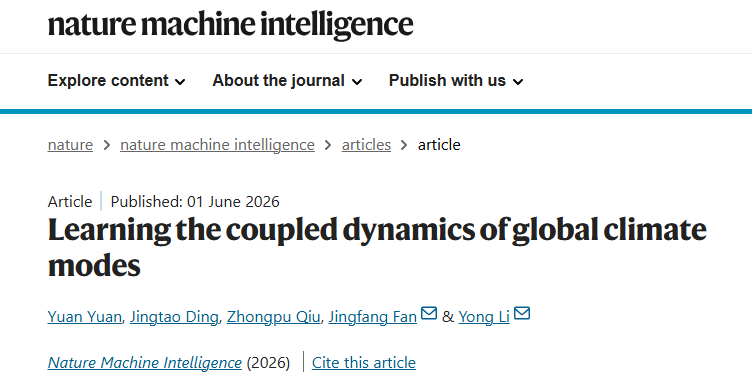
The full abstract is as follows:
Global weather extremes, from monsoons to droughts, are shaped by a network of recurrent, coupled ocean–atmosphere patterns known as climate modes. These modes, spanning from the Pacific’s El Niño-Southern Oscillation to interconnected patterns in the Indian and Atlantic Oceans, form a dynamically linked global system governed by complex nonlinear interactions. Holistically forecasting this interconnected system—rather than treating modes in isolation or in simplified pairs as existing approaches do—remains a fundamental challenge in machine intelligence for complex systems. Here we introduce UniCM, a unified deep model for global climate modes forecasting. Its key innovation lies in a dual-branch architecture that learns the dynamics of a coupled system directly from data, achieving a truly unified prediction through the synergistic modelling of localized dynamics and their collective global couplings. UniCM achieves strong performance in unified global climate-mode forecasting, outperforming strong existing baselines and extending the skilful forecast lead time across multiple major climate modes. It successfully captured the diversity of historical events, from the extreme 1997–1998 El Niño to the prolonged and challenging 2020–2023 triple-dip La Niña. Beyond accuracy, UniCM offers interpretability; its internal attention mechanism identifies dynamic precursors and quantifies the structured inter-mode interactions that precede extreme climate events. Our results demonstrate that learning the coupled dynamics of climate modes as an interconnected system unlocks emergent predictability, laying a foundation for unified forecasting and data-driven insights that deepen our understanding of global ocean–atmosphere dynamics.
Reference: https://www.nature.com/articles/s42256-026-01245-5