

Professor Huang Ronghuai Invited to Share Insights on AI-Empowered Inclusive Education at the 10th International Conference on ICT and Accessibility (ICTA' 25)
From December 7 to 10, 2025, the 10th International Conference on ICT and Accessibility (ICTA' 25) and the 2nd International Conference and Forum on Assistive Technologies for Special Needs (ATSN' 25), hosted by the Kuwait College of Science and Technology (KCST), the Arab League Educational, Cultural and Scientific Organization (ALECSO), the Research Laboratory on ICT and Electrical Engineering (LaTICE) at the University of Tunis, and the Tunisian E-access Association, were grandly held at the Kuwait College of Science and Technology. With the theme "Artificial Intelligence and Innovative Technologies for Digital Inclusive Education," the conference focused on research and innovation at the intersection of ICT and accessibility, as well as frontier advancements in assistive technologies for persons with disabilities, digital accessibility, and inclusive education. It attracted over 200 scholars engaged in artificial intelligence and inclusive education and persons with various types of disabilities from more than ten Arab countries. Amthal Al-Huwailah, Minister of Social Affairs of Kuwait, and Ghada Eltahir Mudawi, United Nations Resident Coordinator in Kuwait, attended the conference and delivered remarks.
Professor Huang Ronghuai, UNESCO Chair on Artificial Intelligence in Education was invited to attend the conference and delivered a speech at the forum. He pointed out that against the background of accelerated development in artificial intelligence and human-machine collaboration, learning support technologies for people with special challenges are embracing important opportunities for innovative development. He emphasized that the cooperation between Beijing Normal University and the Arab League Educational, Cultural and Scientific Organization (ALECSO) has a long history. After co-establishing the Joint Laboratory of Open Educational Resources in 2017, the two parties jointly launched the "Joint Laboratory on Artificial Intelligence in Special Education (Arab Region & China)" during 2025 Global Smart Education Conference. This laboratory aims to promote cross-cultural and cross-regional educational innovation and fostering inclusive education and social inclusion through the industry-academia-research transformation and regional promotion of artificial intelligence and robotics technologies. Based on this, Professor Huang Ronghuai called for further strengthening the cooperation between China and Arab countries in the fields of artificial intelligence and inclusive education, continuously deepening the construction of the joint laboratory, integrating the high-quality resources of both parties to develop more precise, scientific, and scalable support solutions for relative groups. He extended a sincere invitation to research teams from Arab countries to join efforts with the laboratory in collaborative research.

Professor Huang Ronghuai Delivering a Speech at the forum
The collaboration initiative has formally received multi-party endorsement. A cooperation memorandum was jointly signedby Professor Huang Ronghuai alongside representatives from participating institutions. The signatories included Professor Mohamed Jemni (Director of the ICT Department, ALECSO), Professor Imed Jabri (Dean of the National Engineering School of Tunis), Professor Khalid Al-Begain (President of KCST), Dr. Mario Franco (President of “Millennium@Edu” Sustainable Education), and Dr. Assad Hafeez (Representative of the World Health Organization). This memorandum marks the opening of a new collaborative chapter. It establishes a clear framework to guide subsequent phases of joint research, pilot practices, and the promotion of achieved outcomes.
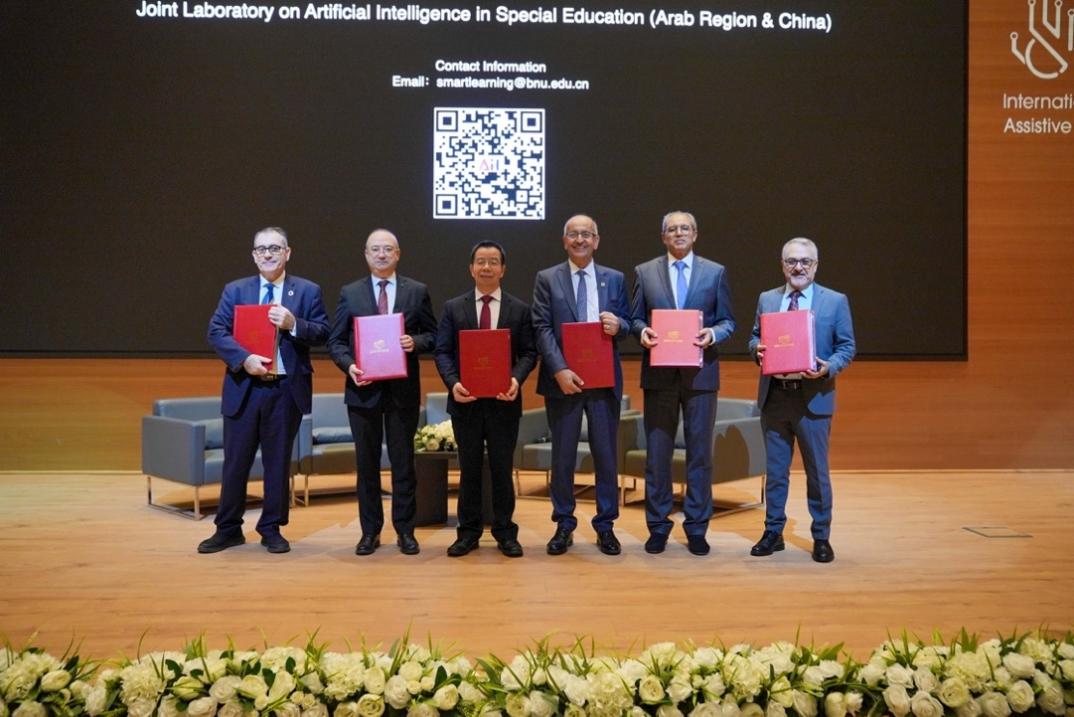
Representatives of All Parties Signing the Cooperation Memorandum
The key research directions of the joint laboratory were then released through an AI digital human: First, building inclusive smart learning environments. Focusing on groups with developmental disorders and learning difficulties, advancing research on the cognitive, social, and behavioral mechanisms of AI-enhanced learning, and establishing early screening and intervention models; Second, developing immersive AI-empowered solutions. Promoting the application of robotics, intelligent agents, and human-machine collaborative teaching models in the learning of people with special challenges, providing personalized learning support for groups such as those with visual impairments, hearing impairments, physical disabilities, and psychological challenges; Third, building cross-regional educational monitoring systems and multimodal databases. Through cross-cultural data construction and comparative research, providing a reliable data foundation and decision-making reference for policy-making and industry practices.
As the first joint event of ICTA and ATSN, a major highlight of this conference was that representatives of persons with disabilities from Arab countries initiated and took to the stage to share their real gains and feelings from participating in various practices, profoundly emphasizing that "accessibility," "assistive technology innovation," and "inclusive design" are core elements of the digital transformation of education. The conference is dedicated to showcasing cutting-edge achievements, promoting assistive technologies, discussing inclusive policies, and promoting substantive cross-border and cross-industry cooperation. At the same time, it highly aligns with "Kuwait Vision 2035" and the United Nations Sustainable Development Goals (SDGs). Through rich forms such as academic papers, keynote speeches, innovation exhibitions, and public seminars, it demonstrated the shared commitment to using artificial intelligence to empower persons with disabilities, promote innovation, and advance digital inclusion.
Professor Huang Ronghuai was also invited to attend the “Advancements in Assistive Assistive Technologies & Accessibility in the Region" panel discussion session hosted by Professor Khalid Al-Begain, the president of KCST, where he shared insights on topics such as integrating experiences from various countries and promoting cross-border cooperation. Postdoctoral researcher Chen Ying from the Smart Learning Institute of Beijing Normal University, on behalf of the laboratory team, shared the Chinese approach of artificial intelligence supporting special education, systematically elaborating on China' s policy practices, technological explorations, and application achievements in AI-empowered inclusive education, and highlighted the team' s research on intelligent agents and robots supporting groups with multiple disabilities. Associate Professor Ahmed Tlili from Beijing Normal University attended the conference and participated in the discussions.
Professor Huang Ronghuai and his delegation were also invited to participate in "Then Scent of Colors" workshop hosted by artist Suheil Baqaeen. The workshop aims to help persons with visual impairments break through color barriers, encouraging them to strengthen social integration through methods such as artistic creation and group work. Additionally, the team also visited the Center of AI & Robotics at the Kuwait College of Science and Technology and had in-depth exchanges with President of KCST Professor Khalid Al-Begain and key faculty members of the college on technology R&D and cooperation opportunities.
This event not only showcased the international influence of the UNESCO Chair on Artificial Intelligence in Education in the field of "AI and Inclusive Education" but also signaled a deepening of its partnership with leading research institutions in the Arab region. Looking ahead, the "Joint Laboratory on Artificial Intelligence in Special Education (Arab Region & China)" will carry out a series of joint research, covering key areas such as sign language intelligent agents, vision enhancement and drawing assistance technologies for visually impaired people, and robot emotional assistance and cognitive training.