

Professor Zhang Zhao's Team from the School of National Safety and Emergency Management Published a Research in Nature Communications
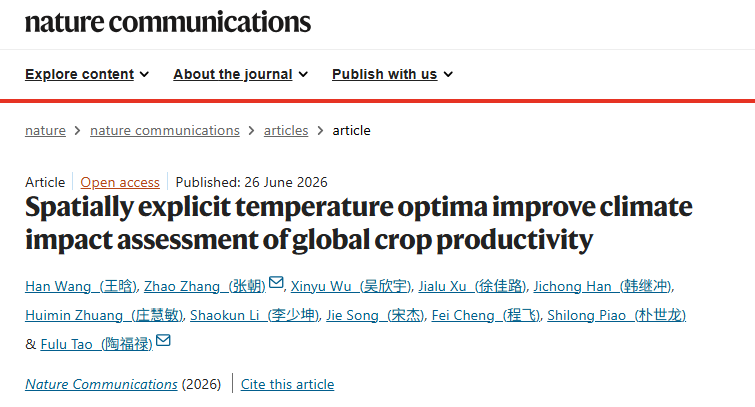
Recently, a team led by Professor Zhang Chao from Beijing Normal University, in collaboration with Researcher Tao Fulu from the Institute of Geographical Sciences and Natural Resources Research, Chinese Academy of Sciences, and Professor Pu Shilong from Peking University, published the latest research in Nature Communications. For the first time, they present 0.05-degree resolution global maps of temperature optima for four major food crops(rice, soybean, maize and wheat). Their analysis reveals pervasive spatial heterogeneity in temperature optima within species.
Abstract:
Climate impact assessments on crop productivity typically rely on globally constant temperature optima, overlooking physiological acclimation across spatial temperature gradients. This limits predictive accuracy under progressive climate warming. Here, we present 0.05-degree resolution global maps of temperature optima for rice (mean ± spatial Standard Deviation: 28.63 ± 2.65 °C), soybean (27.34 ± 2.34 °C), maize (26.12 ± 3.46 °C), and wheat (24.73 ± 3.41 °C), derived from satellite-based proxies of gross primary productivity and validated against eddy covariance flux observations. Our analysis reveals pervasive spatial heterogeneity in temperature optima within species, peaking in subtropical regions. This thermal acclimation is shaped by local temperature, water availability, and solar radiation, highlighting a phenotypic plasticity in crop thermal responses. As warming accelerates, growing-season days exceeding local temperature optima are increasing, contracting the thermal safe space, particularly in tropical and subtropical zones. This poses significant risks to maize and rice productivity. Integrating spatially explicit temperature optima into climate impact models improves global crop productivity projections by approximately 16 ± 2%, and by up to 22 ± 4% for temperate crops. These findings underscore the necessity of incorporating spatially explicit thermal responses into Earth system models to refine agricultural projections and inform targeted adaptation strategies.
Reference: https://www.nature.com/articles/s41467-026-74564-1