

Global Best Cases of Future Education Design Published: K–12 Teachers Map the Landscape of Educational Innovation
Recently, a new case collection, Empowering Educational Innovation Through Design: Best Practices from K–12 Teachers, has been published by Springer. Edited by experts from Beijing Normal University (BNU) and other institutions, the volume showcases outstanding cases from the K–12 Track of the Global Competition on Design for Future Education (GCD4FE). It brings together the practical wisdom of frontline teachers from China, Hungary, Indonesia, and beyond, demonstrating how design thinking can be applied in K–12 settings and offering replicable, scalable models for transforming education.
As a key annual activity of the World Digital Education Alliance, GCD4FE was upgraded in 2026 to the Global Competition on Design for Futures (GCD4F). The K–12 Track, launched on 1 March, focuses on AI‑empowered education and calls for innovative solutions that contribute to building inclusive, equitable, and quality education worldwide.
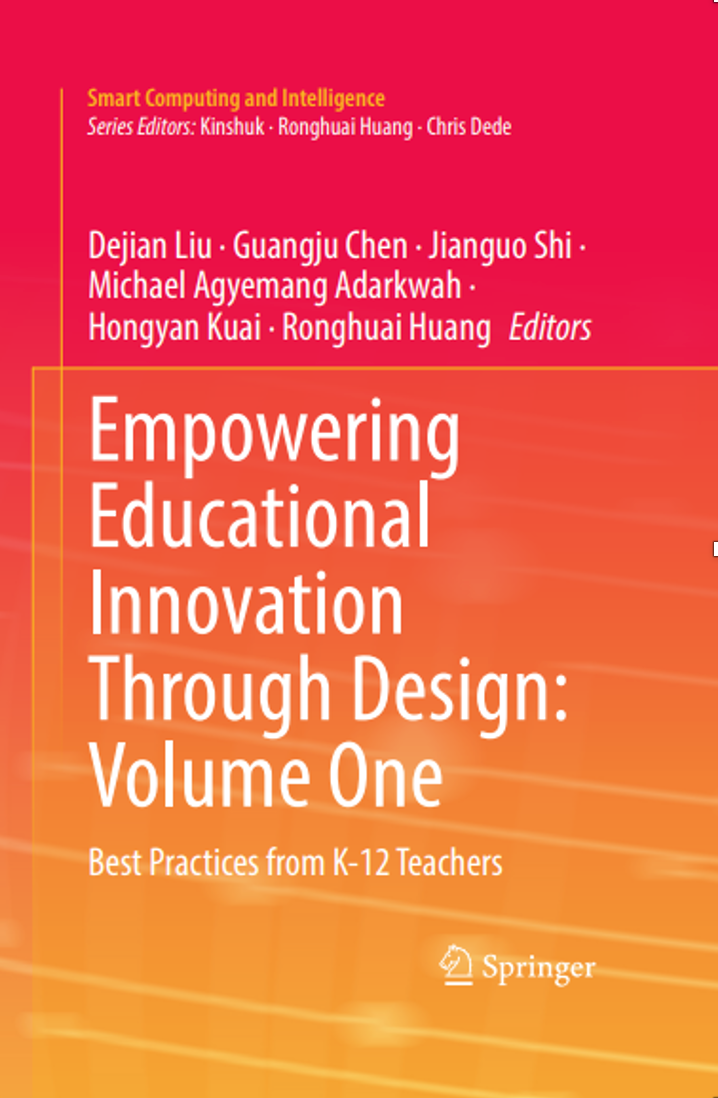
Empowering Educational Innovation Through Design: Best Practices from K–12 Teachers
Deepening the K–12 Track: Frontline Teachers as Drivers of Educational Innovation
Co-organized by BNU and UNESCO Institute for Information Technologies in Education (IITE), the GCD4FE has been held for eight consecutive years since 2018, attracting tens of thousands of participants from over 40 countries and regions. To further promote innovation in K–12 education, it launched a dedicated K–12 track in 2021. Over the past five years, nearly 10,000 K–12 teachers from around the world have taken part, contributing a wide range of creative and practical cases. The newly-published case collection is a concentrated reflection of these outcomes.
Prof. Ronghuai Huang, Dean of the Smart Learning Institute of BNU and one of the book’s editors, notes that educational design can be categorized into five types: product design, solution design, service design, mechanism design, and policy design. The selected cases cover all five types, addressing key issues in global K–12 education—such as student competency assessment, mental health management, interdisciplinary teaching, reading literacy, cultural heritage education, rural education revitalization, special education support, and labor education innovation. Together, they provide teachers with practical, replicable, and scalable models.
Empowering through Design Thinking: Reconstructing Pathways for K–12 Innovation
Mr. Jianguo Shi, Executive Deputy Director of the China Education Equipment Institute and another editor of the volume, has long focused on the application of design thinking in education. He outlines six steps: needs analysis, problem definition, ideation, prototyping, iteration, and outcome dissemination. The core of design thinking, he argues, is to build bridges among problem/task framing, pedagogical principles, technological empowerment, and classroom practice. Prof. Jiaxian Zhou, Deputy Director of the Centre for Educational Neuroscience at East China Normal University and GCD4F expert, also recognizes the value of design thinking. She believes that educational neuroscience provides participants with evidence‑based design approaches, helping to ground instructional design in scientific evidence.
Starting from real pain points, teachers have applied design thinking across disciplines and grade levels. Examples include: using process‑oriented data feedback to guide writing instruction in language arts; leveraging AIGC for human–AI collaborative creation on the theme of “Future Cities” in the arts; using sensors and open‑source hardware to develop waste liquid treatment systems in science education; combining educational neuroscience with smart wristband data to optimize physical activities during recess; and building end‑to‑end management mechanisms for mental health through digital platforms.
Technology for Good: Deep Integration of Frontier Tech and Educational Contexts
Driven by global digital transformation, the manuscript highlights how frontline educators have moved beyond using AIGC, metaverse, Big Data, IoT, and AR as mere “tools” towards a deeper “ecological integration.” This is not just a record of technology in the classroom, but an exploration of how technology can reshape the core of education. Teachers are no longer satisfied with simple tech adoption; instead, they are making technology an endogenous driver of pedagogical innovation.
The cases exemplify the principle of “technology as a carrier of deeper educational wisdom.” Examples include: the “Big Data of Small Seeds” platform developed by Harbin Garden Elementary School, which uses contextualized assessment and big‑data visualization to enable large‑scale personalized instruction; the “Magic Space” created by Seven-Color Flower Elementary School, which uses smart interaction and immersive projection to energize physical education, English, and science lessons in a limited physical space; and a digital curriculum resource package developed by No. 2 Junior High School, Tibet Autonomous Region which addresses the urgent health education needs of children from pastoral families, effectively improving health literacy on the plateau. These initiatives resonate with UNESCO’s commitment to leveraging accessible, affordable, and user‑friendly digital technologies to foster inclusive development, fully embodying the educational value of technology for good.
Voices of Global Teachers: Shared Aspirations across Diverse Cultural Contexts
This case collection is a true “collection of practice‑based voices” from K‑12 teachers worldwide. It brings together educators from different countries and regions, each offering deep insights and innovative responses to local educational challenges. The cases transcend borders, cultures, and disciplines, demonstrating the collective wisdom of K‑12 educators in addressing common challenges.
For example, an Indonesian teacher team used design thinking to develop an “Ethno‑STEAM” curriculum that harnesses the traditional Klenang Sasak instrument to rekindle rural students’ enthusiasm for learning and strengthen their cultural identity. A Hungarian teacher team designed an intercultural curriculum around the theme of “Unity in Diversity,” helping students from diverse linguistic and cultural backgrounds build trust and collaboration. Meanwhile, Chinese teachers have also made their voices heard: teachers from Beijing Fengtai District Vocational Education Center School created “AI Ancient Architecture” educational toys, enabling students to explore the science and culture of historical buildings through hands‑on construction; and teachers from Beijing No. 8 Middle School built an online–offline integrated platform for “whole‑book reading,” removing spatial and temporal constraints to foster independent reading and critical thinking.
Connecting Multiple Dimensions of Value: Toward a Closed Loop for K–12 Innovation
As a living repository of innovative K–12 practices from around the world, this manuscript offers multiple layers of practical value—for teacher development, school improvement, and broader social progress—and has initially formed an innovation loop connecting “teacher practice – school reform – regional scaling.”
From the teacher perspective, each participant becomes an action researcher in design thinking. In solving authentic problems, they not only strengthen their interdisciplinary teaching abilities and technology application skills but also transition from being “lesson deliverers” to “learning designers.” From the school perspective, these school‑based practices provide transferable methodologies and operational models for schools with different conditions to advance curriculum reform and optimize student development. From the societal perspective, the innovative solutions related to rural education revitalization, cultural heritage, adolescent mental health, and special education not only respond to contemporary issues but also offer valuable practical references for education policy‑making and philanthropic project design.
Looking ahead: Sustaining Innovation and Transformation in K–12 Education
Prof. Guangju Chen, Chair of the Steering Committee of GCD4F and one of the book’s editors, emphasizes the importance of staying committed to the core mission of education, empowering teaching through technology, and supporting student development through teacher growth, and safeguarding the healthy development of the youth. This manuscript is not only a showcase of innovative achievements by K–12 teachers worldwide but also a positive response to UNESCO’s “Futures of Education” initiative. Through this volume, the practical experience of outstanding global teachers is systematically documented and widely disseminated, enabling more educators to benefit from sound design concepts and practices, and collectively advancing high‑quality educational development.
It is worth noting that outstanding cases from the K–12 track of the 9th GCD4F will continue to be included in the publication series. These innovative outcomes will also be transformed and implemented through teacher training, regional promotion, and international cooperation. An increasing number of K–12 teachers, guided by design thinking and supported by technological innovation, will continue to move forward in the wave of K–12 transformation, contributing their wisdom to cultivating innovative talents for the future.
Link:https://link.springer.com/book/10.1007/978-981-95-4621-3