

Professor Huang Ronghuai Attended the 2026 ENNOIA Symposion and Delivered Keynote Address
From June 3 to 5, the 2026 ENNOIA Symposion, “Prediction, Purpose, and the Becoming of the Human Person,” was held in Berlin, Germany. The event examined how the rapid development of artificial intelligence is reshaping human cognition, the nature of education, and the formation of agency. Through interdisciplinary dialogue, participants addressed questions such as what learning is for, how learners grow into agentic persons, and what kinds of learning truly serve human development. The discussions explored how education can continue to support the holistic development of the human person amid technological change.
The Symposion brought together more than 50 leading scholars from around the world in education, philosophy, neuroscience, computer science, AI ethics, and related fields. Participants included Howard Gardner, Professor at Harvard University and originator of the theory of multiple intelligences; Andreas Schleicher, Director for Education and Skills at the Organisation for Economic Co-operation and Development (OECD); danah boyd, Professor at Cornell University and founder of Data & Society; Shannon Vallor, Professor of AI Ethics at the University of Edinburgh; Hiroshi Ishiguro, roboticist at Osaka University; and David Poeppel, neuroscientist at New York University. Professor Huang Ronghuai, Co-Dean of the Smart Learning Institute at Beijing Normal University and UNESCO Chair on AI in Education, attended the Symposion by invitation and delivered a keynote address titled “How to Become an Authentic Agentic Active Learner in the AI Era.”
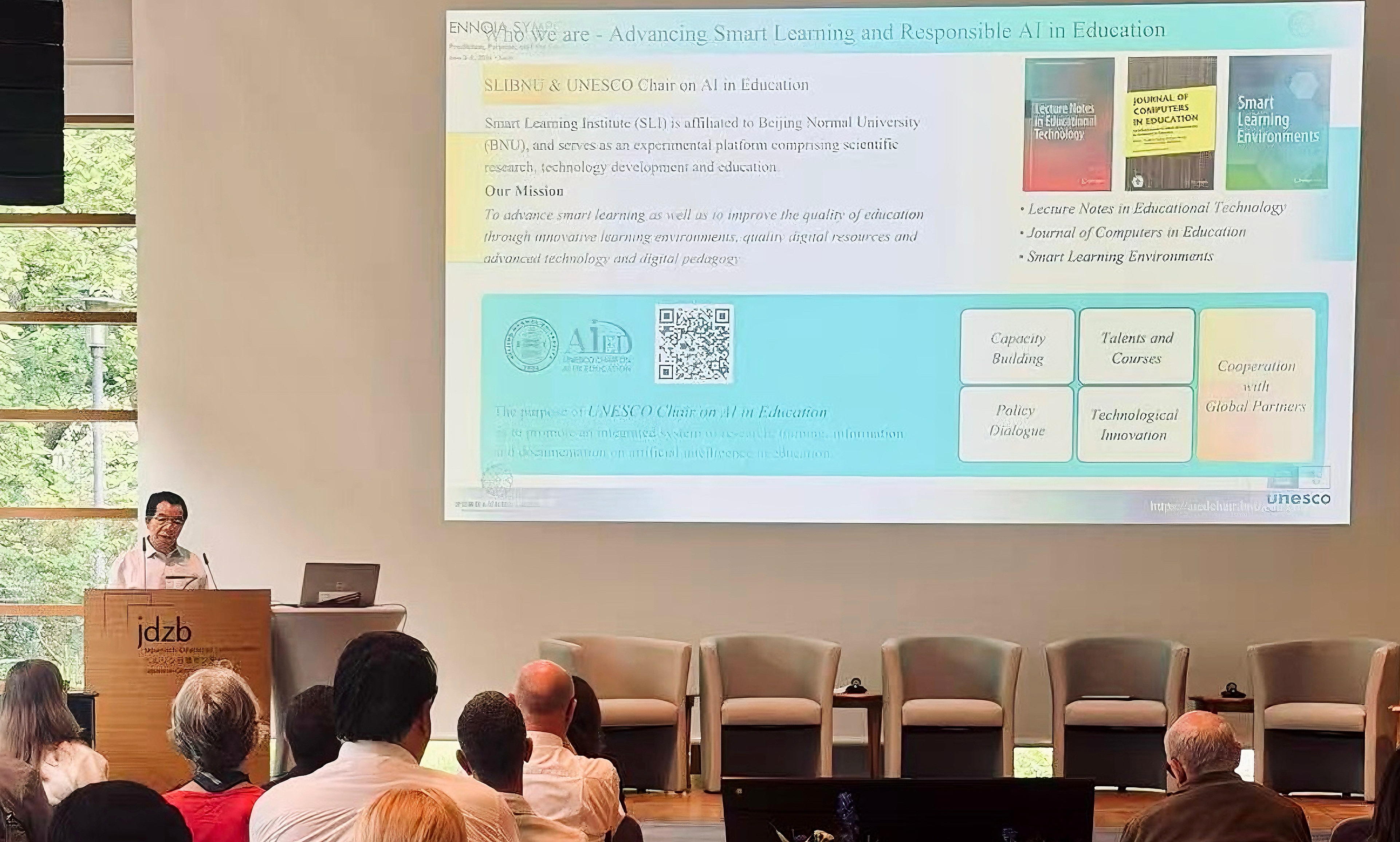
Professor Huang noted that the accelerating evolution and widespread use of AI are reshaping the basic paradigms of knowledge production, social development, and individual growth. These changes, he said, are also leading educational researchers to revisit foundational questions about the conditions that make education, learning, and agency possible in an intelligent society. As society and education become increasingly digital, networked, and intelligent, learning environments are expanding and being reconfigured. Informal learning beyond the classroom, large-scale patterns of knowledge production, school systems, and talent-development models are all undergoing profound change, driving a systemic transformation of the key elements of learning and education. As human-machine collaboration becomes a basic mode of production, daily life, and learning, how learning happens and how education is provided should be understood as a multi-layered framework of commitments. This framework spans five levels: society and culture, government and policy, schools and families, teachers and students, and learners’ commitment to themselves.
He proposed that, in the intelligent era, learner self-empowerment will become a fundamental driver of learning. The central task of education is no longer simply to transmit established knowledge. Rather, it is to cultivate learners’ capacity for agency: the ability to actively construct meaning, continually renew their capabilities, use resources wisely, engage with technology prudently, and guide their own development.
He outlined three priorities: first, cultivating IAAA learners, namely Intrinsic, Authentic, Agentic, and Active Learners; second, promoting a shift from linear learning to synthesis-based learning; and third, building an educational ecosystem in which silicon-based collaboration and human-machine collaboration form two mutually reinforcing cycles.
ENNOIA derives from ancient Greek and means “understanding.” In the Stoic tradition, it denotes a faculty of understanding shared by human beings as such. Initiated and supported by the Kata Agorein Foundation, the ENNOIA Symposion series serves as an interdisciplinary platform for international exchange. Taking “Being Human in the Age of AI” as its enduring intellectual frame, the series fosters cross-disciplinary inquiry into the roles, values, and future of human beings in the age of AI. The forum stresses that understanding is not a body of knowledge possessed by isolated individuals, but a capacity that takes shape through encounter, dialogue, and shared reflection. In response to the far-reaching changes brought about by AI, the ENNOIA Symposion series places “relationality” at the heart of human becoming, scientific inquiry, educational change, and the making of a shared world. Through interdisciplinary exchange, it continues to ask what human agency, responsibility, and future possibilities can mean in a technological age.